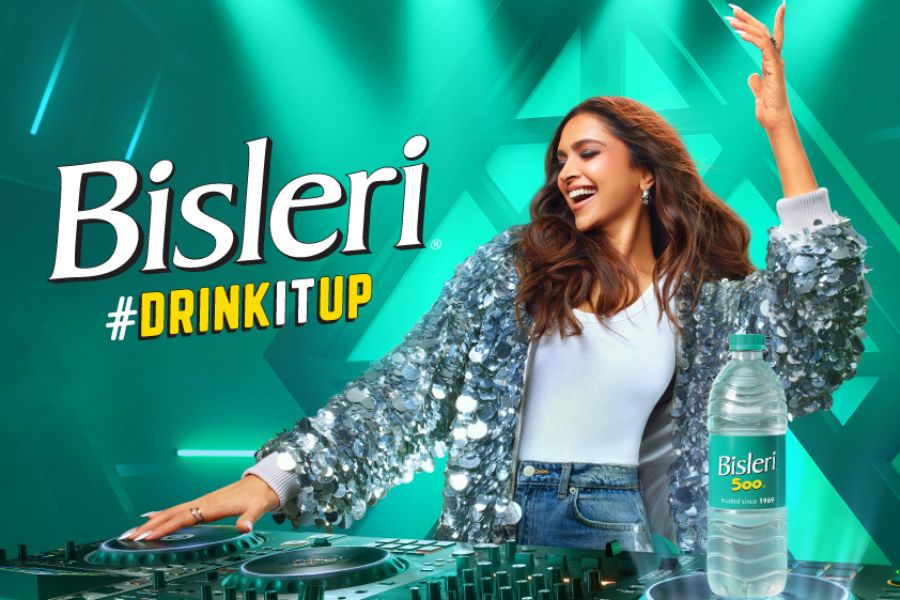
If you exit Delhi’s Indira Gandhi International Airport’s T3 terminal, it is difficult to miss a 40-foot Deepika Padukone staring down from a billboard, sipping from a Bisleri bottle. The brand has held this OOH site for more than two years.
This is an unblinking reminder that packaged water, often treated as a low-involvement category, can still command visibility that is typically reserved for flagship FMCG launches. That image now anchors Bisleri International’s latest campaign, Drink It Up 2.0.
Fronted again by its global brand ambassador Padukone, the campaign pushes hydration into lifestyle territory rather than functional necessity. Shot with a carnival-inspired aesthetic, the ad film leans on fashion, music and high-octane visual energy, with a flatbed Bisleri truck reimagined as a DJ console powering the narrative.
Jayanti Khan Chauhan, vice-chairperson of Bisleri International, calls the campaign an attempt to contemporise the category. “Bisleri has always been synonymous with pure and trusted hydration. With our new campaign, we’re reimagining hydration as a vibrant, youthful, and lifestyle statement. We’re delighted to collaborate again with Padukone, whose energy, authenticity, and global appeal perfectly reflects Bisleri’s evolving spirit,” she stated.
Padukone echoes the positioning. “The new #DrinkItUp 2.0 campaign perfectly captures the spirit of today’s generation, which is energetic, confident, and always ready for an adventure.”
For a brand that has spent five decades building ubiquity in India’s packaged water market, the shift signals a strategic attempt to rebalance functional cues with cultural currency.
Reframing hydration for a new consumer
To unpack the brand’s thinking, Campaign India spoke with Tushar Malhotra, director of sales and marketing at Bisleri International, who has overseen the evolution of the Drink It Up platform. He says the pivot began with a sharper reading of Gen Z behaviour.
“Since Gen Z is extremely keen on hydration, we thought why not make hydration and celebration the functional benefit of water and move this product into a lifestyle expression,” Malhotra noted.
Bisleri’s long relationship with mass-market communication—from the camel Baadal who championed purity and safety, to the ‘Kiss to Drink’ campaign promoting personal packs—gave the company a wide palette to work from. But the new cohort, he says, needed a different narrative.
That shift informed the creative brief: an upbeat international soundtrack, a sunny Mumbai street, street-side characters, and the now-familiar Bisleri bottle flip. This is an asset that Malhotra says the brand “now owns, literally.”
The campaign was conceptualised through a collaboration between Zero Fifty Media Works, Bisleri’s in-house creative team, and director Uzer Khan, with celebrity and music partnerships handled by GroupM. The hybrid model reflects the breadth of Bisleri’s current marketing systems across digital, OOH and sports partnerships.
The timing was also intentional. “Seasonality is pretty constant in the drinking water segment. Yes, there are certain spikes. But December is also a big spike for us in terms of celebrations. And the Drink It Up 2.0 campaign resonates with that feeling of celebration as well,” he says.
What the first edition revealed
The new campaign builds on the insights gleaned from the original Drink It Up launch last year. Malhotra says the category’s old differentiator—purity—is now a baseline. “Quality and purity are table stakes for established water brands today. You can't talk quality and differentiate yourself,” he says.
A youth study conducted by the company reinforced a broader shift: hydration had moved from utility to a part of fitness, self-care and cultural expression. Music and movies, with rapper Hanumankind and actor Padukone as crossover figures, provided the cultural scaffolding the brand could plug into. “That’s where the relevancy comes in,” he adds.
The task, therefore, was not to restage functional superiority but to establish Bisleri within the textures of contemporary culture—pop, sports, street and social.
For Drink It Up 2.0, the media plan spans Instagram, YouTube, CTV, impact buys in sports, retail visibility and half a million outlets with dealer boards. Experiential activity remains central. “Between Bisleri, Vedica and our carbonated soft drinks, we do over 250 events and are one of the largest experiential marketing brands in the country,” he says.
Sport: The second marketing engine
A significant share of Bisleri’s current visibility comes from its expanding sports footprint. “If I take the ‘Drink It Up’ campaign, one pillar is pop culture expression, which you see with Deepika, and the other is a sports expression. We are building a strong, emotive connect with sports and the largest sports marketing player in India's and Middle East with over 60 sports collaboration, including teams in the IPL, ISL, hockey, tennis, golf, marathons, etc,” Malhotra explains.
Its associations extend far beyond mainstream formats. Bisleri is present in adventure sports via Red Bull, the Padel League, WTA tennis, the Mubadala Abu Dhabi Tennis Open, the Indian Racing Festival (IRF), the Indian Racing League (IRL) and Formula 4 India. It is active in chess and eSports too.
“We are there almost in every sports genre,” he notes, adding that conversations with the BCCI continue.

Film tie-ins and special-edition packaging have become recurring elements of Bisleri’s playbook. But Malhotra stresses that novelty cannot come at the cost of consistency. “We believe in simplicity at scale and reaching out to the consumers at multiple touch points with the same messaging. Because then they notice it, imbibe it, and make a habit out of what we are trying to communicate about having water as a lifestyle expression,” he says. Recent examples include the Mission: Impossible – The Final Reckoning bottle collaboration in May 2025.
A portfolio that moves beyond water
While water builds the company’s core equity, Bisleri’s carbonated soft drink (CSD) range has been expanding, with a clear tilt towards flavours rooted in local and pop cultural trends. Spycy Jeera, in particular, sits at the intersection of nostalgia and regional flavour preferences.
This aligns with a 2023 Mintel study that found 45% of Indians are interested in trying ethnic Indian flavours in packaged non-alcoholic drinks, with 41% open to global flavours. New flavours motivate 38% of carbonated soft drinks consumers to experiment.
Malhotra notes that the fundamentals remain constant across categories. “The one thing which cuts across everything in the carbonated soft drink category is product quality, consistency and taste. Those are the basics that we need to get right.”
Above this, each brand takes its own cultural position: Limonata promises ‘Double the chill’, Bisleri Pop leans into sweetness and nostalgia, while Spycy Jeera uses a more rustic tone with Anjali Sivaraman as ambassador.
Innovation, therefore, hinges on relevance. “This means taking what is in, what is trendy, what's being built, and then making it better,” he says.
Another strategic pillar is Vedica, Bisleri’s Himalayan Spring water. It sits firmly in the premium segment and appears across 70–80 lifestyle events—from GQ and Condé Nast gatherings to the Jaipur Literature Festival—where water as a lifestyle marker is more pronounced.
On budgets, Malhotra keeps details close. “I cannot share marketing numbers, because we are a privately held organisation, but it's a healthy budget, and we are very smart on how we use it as well,” he says. Marketing spend, he notes, has grown in line with double-digit sales growth.
Hydration meets pop culture
The timing of Bisleri’s repositioning aligns with broader global shifts. Functional waters, wellness cues and celebrity-driven hydration brands have reset expectations, especially among younger demographics.
In India, where packaged water traditionally competes on purity and price, the push to embed a bottle brand inside pop culture, sports ecosystems, and fashion-coded narratives marks a notable pivot.
Whether Drink It Up 2.0 can shift behaviour or simply raise visibility is something the market will determine over time. But in a category where differentiation is thin and distribution battles often decide share, the attempt to reframe hydration as a cultural act is a strategic experiment worth watching.
As travellers leaving IGI Airport continue to discover, some brand cues are designed to be impossible to ignore. The question that marketers in this category and their agencies need to ponder is whether lifestyle-driven hydration can become a durable platform or a moment shaped by cultural timing. For now, Bisleri has placed its bet.