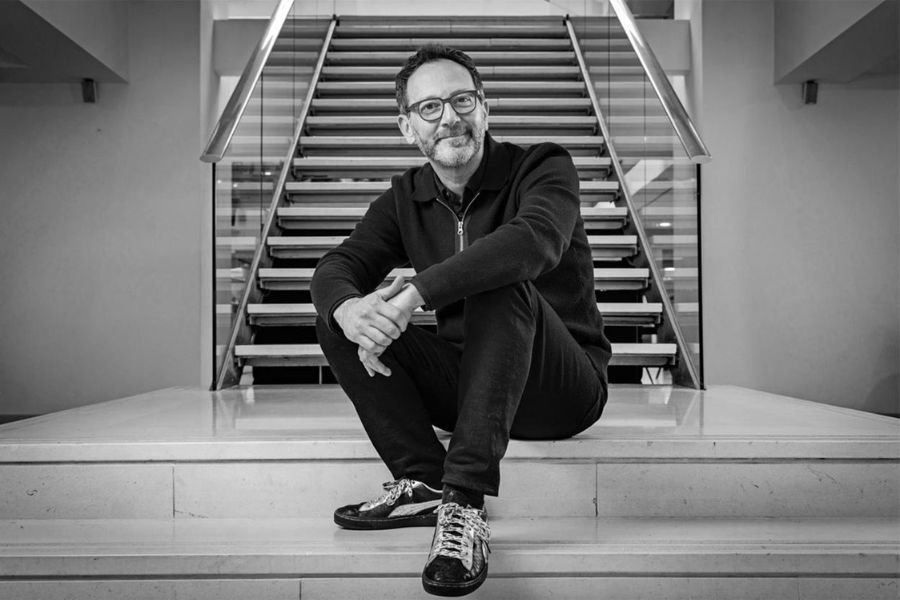
Zaid Al-Qassab is on a mission to change how ‘the outside world thinks of M&C Saatchi’

The new CEO tells Campaign why the agency group must become a solutions-based business, look beyond traditional advertising, and embrace learnings from markets including Singapore and Sydney.

Once upon a time, M&C Saatchi’s founders used to have their offices in a private lair on the seventh floor at the top of their Golden Square headquarters in Soho, but Zaid Al-Qassab—the new chief executive—is based on the ground floor.

Dressed in a black, zip-up cardigan, trousers and trainers, despite his new status as chief executive of a listed company, Al-Qassab has a desk just a few steps from the reception where he can greet visitors with ease.

He joined in early May and has already been visibly active, posting on LinkedIn about his global tour of the M&C Saatchi network, teasing a new logo and brand positioning at Cannes Lions, and announcing promotions and appointments, including Jo Bacon as UK group CEO and Marcus Peffers as UK group chair.

Al-Qassab, who was previously chief marketing officer of Channel 4 and responsible for its acclaimed idents, which won multiple Gold Lions at Cannes in June, knows the power of branding and messaging to shape perceptions.

Al-Qassab makes himself comfortable in the M&C Saatchi offices

When he first landed the M&C Saatchi job in February, he recalls how quite a few people asked him varying versions of “Are you completely mad?’’ and “Why on Earth would you do that?”

What’s more, he has never been a CEO of a listed company and wider macro-economic conditions remain tough.

But Al-Qassab, who spent two decades at Procter & Gamble and was also chief marketing officer of BT, says he was up for the challenge of moving agency side for two reasons. 

“First, I'm not running an agency, I'm running a group. I have experienced CEOs who run the agencies in this group,” he tells Campaign, giving his first UK interview since taking the job.

“Second, I think it's immensely helpful to have a client in this position because the world has changed a lot and continues to change incredibly fast. Clients are finding that very difficult and complex. At the end of the day, the agencies that win will be the ones that understand their clients best. And I thoroughly understand clients.”

Combining agency expertise with an understanding of clients can be a “very powerful proposition", he says.

Despite making some quick moves in his first weeks in the job, Al-Qassab has sought advice. He has met all the previous leaders, including Moray MacLennan, his immediate predecessor, and the four founders, David Kershaw, Jeremy Sinclair, Bill Muirhead and Maurice Saatchi, who set up M&C Saatchi in 1995 as a breakaway from Saatchi & Saatchi.

M&C Saatchi has “a wonderful, rich history of creativity and ground-breaking work and a very famous brand”—“there are very few brand names that my mum has heard of in the advertising world ” he says.

Shareholders have given Zillah Byng-Thorne (below), the chair since June 2023, and Al-Qassab a mandate to turn around M&C Saatchi, after a series of setbacks, including accounting irregularities in 2019, the pandemic and being the subject of two failed takeover bids in 2022.

M&C Saatchi executive chair Zillah Byng-Thorne

There is plenty of work to do at the 2,700-strong agency group, as net revenues went into reverse last year, declining 2% to $327.7 million (£252.8 million). 

The company is valued at about $324 million (£250 million) and the share price trades at about 200p, which is a long way below its 330p level before the accounting problems first emerged.

Byng-Thorne parted ways with MacLennan soon after she arrived and took temporary charge in September, slashing costs and exiting or reducing its interest in a number of subsidiaries, including in Hong Kong, South Africa, Sweden and Switzerland.

Investors are watching with interest. Shore Capital, a City stockbroker, laid out the “bull” and “bear” cases for investing in the agency group in a detailed, 27-page analyst note at the start of July, as the graphic below shows:

“M&C Saatchi is undergoing a transformative restructuring, which is expected to streamline operations, leaving it well positioned to take advantage of a potential improvement in business confidence and higher marketing spend,” Shore Capital said.

Strengths include its “strong, internationally recognised brand” and “diversified portfolio of services”, while risks include “highly competitive and fragmented markets” and the “new, senior team needs to settle and deliver”, according to the City broker.

Al-Qassab formally took over from Byng-Thorne on June 1 and is eager to send out the message that M&C Saatchi is changing and that there is more to the group “than the outside world thinks”.

Looking beyond the UK and traditional advertising

He embarked on his global tour as soon as he joined M&C Saatchi, because, he says: “I believe you get an impression about the business by meeting people, not just by reading things or having Teams calls with the senior members of the business.”

Seeing staff and clients in-person in Singapore, Sydney and elsewhere meant he could better understand each local market and “get a feel for all of them”, Al-Qassab adds.

That mindset fits with his own experience, which has included international roles for P&G. “I’m a mixed-race, British-Iraqi, the son of an immigrant, who has lived in four different countries, so I very much think of myself as a global citizen,” he wrote in an all-staff message, introducing himself on his first day at M&C Saatchi.

Back in London, following his tour, he says he was impressed by the breadth and scale of the group’s talent and capabilities, but also came away feeling they are “much greater than I think the outside world thinks of M&C Saatchi."

The new CEO wants to challenge such preconceptions, not least in London's adland, which can be “myopically focused” on the UK.

As Al-Qassab says: “Sitting in this country, we can be very UK-centric and our industry can be very biased towards traditional advertising work.”

He cites a range of recent work from a consulting brief for PepsiCo in North America to “a multimedia, multichannel campaign” for a pensions brand in Australia as examples of how M&C Saatchi delivers different kinds of work.

There is an opportunity for M&C Saatchi to grow internationally, given 43% of its revenues come from the UK versus 14% for WPP.

M&C Saatchi needs to demonstrate to investors that it is less reliant on advertising, the group’s biggest specialism, which has fallen from 72% to 42% of net revenues in the past five years between 2018 and 2023, according to Shore Capital (see graphic below).

The agency group divides its business into five specialisms, which Al-Qassab says is a “sensible” way to continue presenting the business. 

The other four specialisms are issues (government work), which is now 20% of net revenues, passions (sport and entertainment and influencer marketing) 14%, consulting 13% and media (largely performance marketing) 10%. 

Becoming a “solutions-focused business” 

Al-Qassab has wanted to signal change externally, as much as internally, and teased a new logo and brand repositioning on the first day of Cannes Lions, although it won’t launch properly until later this year.

M&C Saatchi is to become M+C Saatchi and the use of the “plus” symbol is important as part of a new “M+C Saatchi Plus” proposition for clients.

The shift is not primarily about a brand positioning, it's about strategy, according to Al-Qassab. 

He wants to get M&C Saatchi’s specialisms and regions working much more closely to serve clients who are asking for greater simplicity.

“We have a bunch of fantastic specialisms and we need to bring those together in an integrated way so that clients can come to us with a challenge—with an issue they're facing or with an opportunity they've got—rather than with a brief that says, ‘Make X for us’,” he explains.

“We have got to be a solutions-focused business—a client-focused business that says: ‘Whatever your problem is, we will come up with the right solution.’” 

Advertising, he says, might not be the primary answer. “It might be that your brand needs a turnaround either in proposition or in design, somewhere higher up the funnel. It might be that you need us to help with performance marketing right at the bottom of the funnel,” he adds.

An integration strategy is hardly new but many agency groups, including some of M&C Saatchi’s larger rivals, have found it difficult to deliver because of legacy ways of working and structures. 

Clients are crying out for a more solutions-based approach from their agency partners, according to Al-Qassab.

“The world is too complex for clients to navigate nowadays,” he says, although it’s partly up to them to drive change. “I think a lot of clients haven't known how to say: ‘Honestly, here's my problem. I need help solving it.’ Sometimes they are forced by the agencies and the agency structures into writing a narrow brief that says: ‘Please give me this.’ 

“What we want to do is move away from that and move into providing the partnership service that says: ‘Give me your problem and I'll work with you to solve it.'”

That means M&C Saatchi must be “much simpler to deal with externally” for clients, “rather than you needing to talk to several different pieces of the group”, Al-Qassab says.

M&C Saatchi has given more power to regional leaders in key areas—the UK, Europe, the Middle East, the US and APAC—in the new set-up. 

A client should be able to deal with an agency client leader or regional CEO, who is ultimately responsible for delivering what that client needs.

“The mechanics behind it shouldn't matter to the client as long as we come up with brilliant solutions,” Al-Qassab maintains, but it does require incentivising agency leaders to drive collaboration. “The incentive model at a senior level has already changed so that the group is uppermost, rather than the individual units.” 

The group is also looking to drive other efficiencies, by moving more jobs to three low-cost locations in Cape Town (for finance, IT and HR), Delhi (IT, HR and media) and Bangalore (media data, strategy and production)—a shift that is expected to be complete by 2025, according to Shore Capital.

In the “Goldilocks zone” between big holdcos and small independents 

Many other agency groups have already gone down the integration route, most notably Publicis Groupe, with its “Power of One” strategy, which has helped the French group pull ahead of all of its “big six” rivals since the pandemic. 

When Al-Qassab describes “M+C Saatchi Plus” as “the power of everything in M&C Saatchi actually coming together”, it sounds very similar to Publicis’ pitch.

Al-Qassab does nothing to reject that suggestion. “However, we have some things that the big holding companies don't have,” he insists. “We have the ability to be agile and tailor different solutions and genuinely move fast, because we are a fraction of the size.”

He continues: “I think of us as in that ‘Goldilocks zone’, where we [also] have great advantages over [smaller] independents because, across our group, we have every marketing service you could possibly want as a client and [specialist] independents can't possibly do that.”

If M&C Saatchi can combine integration with an “agile” and “fearless” approach, it has a unique point of difference, especially versus the big holdcos, which are “inevitably going to be more bureaucratic, more templated, more process-driven, and less flexible”, he argues.

“And having been a client for many years, I can testify that that's how the world works.”

He has some experience of M&C Saatchi from his client days. He used Re, a customer experience agency, when he was at Channel 4 and employed its public relations agency, previously known as Talk PR, when he was at P&G.

Creativity will be an “advantage” in the age of AI

Arguably, one of the biggest challenges facing the agency sector, not just M&C Saatchi, is persuading clients to invest in creativity when demand for traditional advertising services has been on the wane since before the pandemic.

How much does creativity matter in M&C Saatchi’s new set-up, especially given the London ad agency has cycled through a lot of leaders over many years? Creativity is “absolutely central to our offering”, Al-Qassab responds. 

In “the widest sense of all things”, from ideas and concepts to innovation and new ways of working, creativity is “the key to added value for our clients”.

Creativity is what gives clients an “edge” and “advantage”, he says, explaining it is an important part of the new “Plus” strategy.

Seeking an “advantage” is not just about mining data because “however efficient you are, you also need to be effective”, he says. “And effective means concepts ideas, activations, executions, that human beings react to typically in emotional ways, not just in rational ways. You cannot take the creativity out of what we do, and expect to be brilliant at the job.”

That’s why Al-Qassab made a point of holding sessions with creatives, not just business leaders, during his global tour to discuss “the power of creativity and what we need to do as a group to be the best in the world”, he says. “Because that, at the end of the day, is the thing that makes us different.”

A new, creative duo, Rob Doubal and Laurence “Lolly” Thomson, are joining M&C Saatchi as joint global chief creative officers, after leaving McCann UK earlier this year.

“They are here not just to do kick-ass creative work, but also to get that creative culture and DNA running through every part of the company—fast,” Al-Qassab says.

M&C Saatchi appeared to use the appointment of “Rob and Lolly” for competitive advantage by rushing it out in a 7am stock market announcement in April, before Al-Qassab had formally started.

Senior figures at McCann were said to be disappointed at the way M&C Saatchi handled the news. “Like any football transfer, McCann was aware,” Al-Qassab says, with a hint of amusement in his voice. “Whether it wanted it to happen or not is another matter, but it was aware.”

Betting on creativity could carry risk not only because ad agencies have been under pressure but also because of the disruptive impact of generative artificial intelligence, but Al-Qassab plays down the threat.

“Brands need to reach consumers in ever-more engaging ways, in an ever-more complex world, and that requires creativity,” he says. “And if you look at any of the large studies that have been done, there is more return on investment for a brand by getting the message right and the way it is presented right than there is by perfecting the channel mix.”

He goes on: “We’ve got to get away from the idea that the most valuable things are the things that are easiest to measure when, in truth, the most valuable things are the things that are hardest to measure.”

Hitting it off with Byng-Thorne

One, big question that industry observers ask is how much Byng-Thorne will be involved as non-executive chair. She has a formidable reputation after her days running Future, the publishing group, which she expanded through aggressive M&A, and she has already imposed herself on M&C Saatchi.

Al-Qassab describes her as having beem a “brilliant CEO” at Future, adding: “We certainly have hit it off in terms of the things that we believe in, and the changes that we want to make the group as successful as it can be.”

She gave M&C Saatchi “a very well-considered reset” to get the group “in the right shape for the future” before he joined, but he concedes she made “some pretty tough decisions” during her interim period in charge. “They're always going to be people who find them uncomfortable and people who disagree with them, but ultimately, they were needed,” he says.

Will she be hands-off? “So far, Zillah and I have got the perfect model of working between a chair and a CEO.”

He notes she has other roles outside M&C Saatchi but is easily available. When he was dealing with “a tricky topic” the day before this interview, he texted her for advice. “I want a chair who's involved enough that I can grab the phone and ask them for help whenever I want, and they can guide me on things that I haven't done before, like investor relations.”

The fact that she ran the agency group on an interim basis “is massively helpful, because we can talk about things and both have an understanding of what we're talking about”, he points out.

Keeping talent on-side

M&C Saatchi has seen something of an exodus of talent from its sport and entertainment business, most notably Steve Martin, the global CEO, and Jamie Wynne-Morgan, the UK CEO.

The duo resigned in November and went on to join private equity-backed rival MSQ, where they launched MSQ Sport + Entertainment in June.

Al-Qassab says some departures are not surprising, given that M&C Saatchi has been through a “pretty tough” period, starting with the accounting irregularities in 2019 and then the pandemic and the failed sale talks.

Still, the company told investors at its recent results that it has checked the non-competes on employee contracts in the wake of the staff departures. Was that a tacit message to other potential leavers?

“I don't think that was intended,” Al-Qassab says. Beyond sport and entertainment, “we’ve retained all of our top talent”, although Tim Duffy, a veteran, trusted figure, has stepped back and moved to a consulting role.

A recent employee survey showed M&C Saatchi is “fundamentally a really happy place”, although Al-Qassab stresses that “we need to focus on people” because they are “really the only asset we've got."

He has spoken in the past about his mental health, and supporting talent “matters greatly to me, especially because I've personally experienced depression and anxiety."

Living with mental health issues is “not a reflection on those people's abilities to do their job well”, he says. “I want a diverse workforce, in every sense, in characteristics and in experience, and for them to be able to give their best.”

However, there are still “demands” that come with the job. “There will always be a need for agility, there will always be some amount of unsocial hours or long hours, because we're in the client service business.”

That means ensuring there is a supportive culture. “It's about how we treat people, how we help them to continue to have well-being and feel balanced, while providing that [client] service.”

M&A plans

Looking to the future, M&A activity could play a decisive role in reshaping M&C Saatchi, following two failed rival bids by Advanced AdvT and Next 15.

Relations with Vin Murria, the boss of Advanced AdvT, who controls upwards of 20% of M&C Saatchi’s shares, appear to have improved since Byng-Thorne took over as chair of the agency group. 

Tech entrepreneur Vin Murria first bought a stake in M&C Saatchi in 2020

It is understood that Murria is now supportive of the company, which consulted her over Al-Qassab’s appointment. 

He won't comment on Murria’s previous analysis during the takeover battle, when she said M&C Saatchi should be more proactive in using M&A to expand. “We would never comment on the beliefs or statements of any individual shareholder,” he says.

However, if M&C Saatchi is to be predator, rather than prey, it has some financial firepower. The group has a $64.8 million (£50 million) credit facility, with another £50 million if required, according to Shore Capital, although it still needs to settle some legacy “put options” that are held by agency entrepreneurs in various subsidiaries. 

M&C Saatchi promoted Richard Thompson, who has private equity experience, to global chair of M&C Saatchi’s passions specialism in June and gave him a second, group-wide role as global head of corporate development, with a brief to look for potential acquisitions.

Al-Qassab says: “We’ve been open that we would be interested in selective, bolt-on acquisitions which enhance our capabilities in areas of strategic growth priority.” 

Politically neutral

One area where M&C Saatchi seems unlikely to expand is party political advertising. The agency’s founders relished their reputation as the Conservatives’ advertising agency, from Margaret Thatcher’s 1979 election victory during the Saatchi & Saatchi days to David Cameron’s 2015 win. 

But that’s a distant memory now, and M&C Saatchi stayed out of the 2024 general election. “We are politically neutral,” Al-Qassab says. 

M&C Saatchi does a lot of work for governments, NGOs and charities through its World Services arm, which is part of the Issues division, and those clients are “very happy”, he says. “Nowadays, we thread the needle of being a very adept agency in political spheres, without being politically aligned.”

But would Al-Qassab consider party political work in future? The group would need to “evaluate the opportunity” and consider it “very carefully” because it has so many clients in the government space, he says.

Political work can make an agency famous, in a similar vein to the way political polling helps to boost YouGov’s brand, even though it is just a fraction of its business.

So is it important for M&C Saatchi to make famous work? “It is absolutely essential to make famous work and I’ll tell you why,” Al-Qassab says with gusto. “It’'s not for the PR, it’s because we're in the communication business, and if people aren't noticing the communication, then then it's not cutting through.

“Everyone in our business should be wise to that and you shouldn't be churlish about the fact that we need to do work that's famous and talked about because that means it's great work that people notice.”

If Al-Qassab follows his own advice, he will be looking for more ways to get his agency group noticed. And to change how “the outside world thinks of M&C Saatchi”.