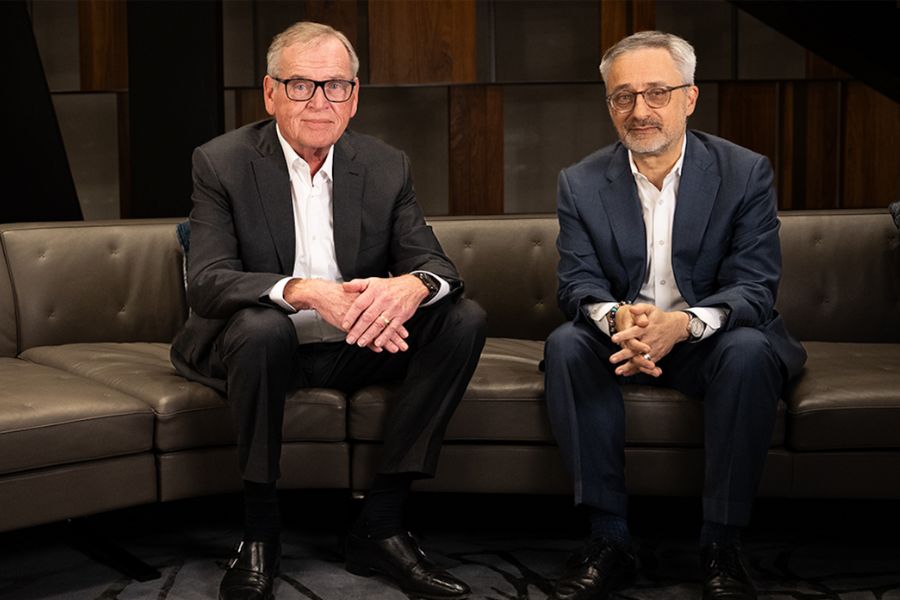
John Wren has told Campaign that Omnicom’s acquisition of Interpublic will mean the merged agency giant can “move much faster” because it will have greater scale in technology and data and can leave behind the “baggage of a legacy advertising group."
“This whole transaction, from my perspective, is about the future, not about any of the legacy issues that existed,” Wren, the chairman and chief executive of Omnicom, said in a joint interview with Philippe Krakowsky, the chief executive of IPG.
Wren said he planned to stay in charge for a “minimum” of three years to win regulatory approval for the acquisition and complete the integration. He has already been chief executive of Omnicom for 27 years.
He added he was conscious that his previous effort to merge Omnicom with Publicis in 2013 failed, even though he argued that deal “could have been incredible” given the performance of those two companies over the past decade.
Publicis has been the top performer since the pandemic, overtaking Omnicom and WPP to become the world’s most valuable agency group, and Wren acknowledged the IPG acquisition was partly a response to the market. “If you look at what people are falling in love with in Paris [in terms of Publicis’ growth] and then how that gets reflected back on the capabilities of people and the rest of the industry”, it is about data, technology and commerce, he suggested.
Combining Axicom, IPG’s data division, with Omni and Flywheel, Omnicom’s data and commerce arms, “brings in a stream of revenue and adds capabilities that the marketplace has questioned”, Wren said.
Krakowsky, who has been chief executive of IPG since 2021, said the merged company needed to move “at speed” to embrace “SaaS-like capabilities”—a reference to recurring revenues like software as a service, rather than more traditional agency-type fees and retainers.
Creative agencies, which have been under pressure across the big agency holding companies, can prosper if they are “plugged into the platform pieces of your business” and “connected to integrated solutions”, according to Krakowsky, who will become co-president and co-chief operating officer, alongside Omnicom’s Daryl Simm, in the planned structure.
Omnicom and IPG have “complementary” assets, including geographical footprint, which will make it easier to serve global clients in every key market, Krakowsky said—a nod to IPG’s relative lack of scale in some countries.
The two companies employ more than 130,000 people and expect to find $750 million (£588 million) of annual synergies, partly through offshoring and reducing duplication. Cuts are more likely to fall on back-office “overhead” than “client-facing, client-servicing” roles, Wren said.
Investors gave a lukewarm reaction to the all-stock deal, which will mean IPG shareholders receive 0.344 of Omnicom stock for each IPG share.
The two businesses were valued jointly at about $31 billion (£24.32 billion) prior to the announcement, Phil Angelastro, the chief financial officer of Omnicom, told an investor presentation.
Omnicom’s share price fell 10% to $92.82, cutting its value to $18.1 billion from $20.2 billion before the news. IPG’s share price rose 3.5% to $30.30, increasing its market cap to $11.3 billion from just below $11 billion. That valued the two companies at around $28 billion—roughly the same as Publicis Groupe.
By revenue, the enlarged Omnicom group would be the largest agency group with annual revenues of $26 billion.
Campaign spoke to Wren and Krakowsky together in a phone interview, following an investor call to announce the deal on Monday morning (9 December) to the US stock market.
What’s the strategic rationale for Omnicom?
Wren said: “This whole transaction, from my perspective, is about the future, not about any of the legacy issues that existed, because our asset base, our geographic base, our account leadership base, do really complement each other.”
He referred to a “newco”—or new company. He and Krakowksy said “from day one”, following the merger, they would look to combine the best of both groups such as principal-based media buying at Omnicom and experiential marketing at IPG.
Wren believes scaling up in data, technology and commerce is key to be the “premier marketing and sales partner” for clients. “Axicom added to Omni added to Flywheel brings in a stream of revenue and adds capabilities that the marketplace has questioned” versus Publicis Groupe’s data unit Epsilon, he said.
There is also financial logic, according to Wren, who pointed out the capital structure of the combined business, with annual free cash flow of more than $3 billion and the long-term maturity of its debt, will give the group more “flexibility” to invest and “removes some constraints."
He predicted that “we can move much faster” as an enlarged company—as “a media platform, a CRM platform, a dynamic content generation platform”—and expand in new areas such as generative artificial intelligence. “We bring all that sophistication to the fore” by combining talents and capabilities, according to Wren.
He went on: “We just complement each other, creating all this cash flow [to invest and pay dividends] and with a management attitude that we're going to move forward-facing. It takes us out of all the baggage that you might find in a legacy advertising group.”
Wren added that scale and integration now matter more than before in a digital and increasingly AI-driven world because of the growing need from clients for data and technology. “I’ve been in this industry a very, very long time” and there used to be practically “no cost of entry” for agencies, beyond great talent, but “that is no longer the case,” he said.
The impact of technology has altered the cost of entry into the sector in a “serious way” and “the technology, the information, the tools that you give to those most talented people, in order to fulfil whatever the client’s requirements are, require a great deal of investment, and to do it in a brand-safe and ethical fashion requires even more intense focus."
He argued Omnicom and IPG both have a “head start” because of their past investments. “You can’t look at the industry any more really from a serious player point of view—maybe you can from a boutique point of view—without understanding that cost of entry has risen quite a bit.”
Why did IPG sell?
IPG did not start out looking to sell as it considered “the best path forward strategically” and “to continue to do the right thing by our clients”, according to Krakowsky. “To say, ‘Why did you sell?’ That wasn’t the purpose of the exercise,” he insisted.
The company looked at a “couple of options” and there were “some conversations”, Krakowsky said, without disclosing anything about potential M&A suitors, but selling to Omnicom “made meaningfully more sense than any other."
Krakowsky began talks with Wren about a year ago and “the more we talked, the more evident it became” about the “benefits” of a merger, especially around tech and data.
Krakowsky said: “What clients need is that holistic view, so that they can make better decisions across all channels—marketing and sales” and find “more outcome-based ways” to drive results. This means agency groups “using technology to enable the various [other] capabilities” within the organisation and moving towards “SaaS-like capabilities”. That is “where we need to go—and we need to go there at speed”, according to Krakowsky.
Geographic fit
Omnicom generates roughly 50% of its revenue from the United States whereas IPG gets about 65% from its home market and the two leaders made the case that the combination would work for both of them.
The merged business will generate about 57% from the US, which Wren said during an investor Q&A was an advantage given geopolitical tensions and the new Trump administration’s more pro-business approach. That could also make it easier to win US regulatory approval for the merger, Wren observed.
By contrast, for IPG, gaining more exposure to the rest of the world will help to service clients, although it brings notable “strengths” in some markets such as Latin America, Indonesia and the Middle East, Krakowsky said.
Up until now, IPG has sometimes had to have an “honest discussion” with a client that operates in 30 or 40 markets around the world and admit it might not be “the best partner for you” in some of those markets because it lacked scale.
Merging with Omnicom means there should be “very few or no gaps in our ability to say, ‘We can get you the best talent, wherever it is that we need to engage with you,’” according to Krakowsky.
Wren added they were willing to sell businesses in certain markets to ensure regulatory approval— an obstacle during the abortive Publicis-Omnicom merger—and they are focused on clearance in around 14 markets, most notably the US and EU. They hope to close the deal by the second half of 2025.
Role of creative agencies?
Wren and Krakowsky said little about the role of creativity during the 20-minute interview, although the investor presentation praised their “bench of top talent” who can “deliver the most creative, innovative and effective ideas” for clients. Both companies have already been streamlining some operations as Omnicom brought its creative shops under Omnicom Advertising Group and IPG sold Huge and has looked to sell RGA.
Asked about the role of creative agencies, Krakowsky said there were still growth opportunities as businesses such as FCB have embraced technology. “You can take what are more—quote, unquote – ‘traditional capabilities’ [and modernise them] if you have leadership teams there and understand the direction of travel for the industry, and understand how to take the data on board, think audience-first,” he said.
“Collapsing brands” was not a viable “long-term strategy” and just thinking “short term”, he added, in an apparent reference to some rival groups such as WPP. “Sure, you jam things together, but it's a lazy answer.”
He went on: “The better answer is, you have the right talent, you have them plugged into the [tech and data] platform pieces of your business, you have them connected to integrated solutions, where what you're showing up and giving the client is the full kind of 360[-degree] support.”
Where will Group find $750 million in annual synergies?
The investor presentation said the merged company would find “synergies” in three main areas—by “optimising the organisation”, “cost of services” and “general admin costs”. That will be achieved through nearshoring and offshoring jobs in cheaper locations, automation and other “platform investments” to drive smarter working.
Job cuts look to be on the cards at the Group, which employs more than 130,000 people at present. The acquisition announcement said the new Omnicom would have “over 100,000 expert practitioners."
Asked if there might be “thousands” of job losses, Wren did not respond directly but said: “A lot of the synergies are going to come out of the overhead side of the business, not the client-facing, client-servicing business.”
He acknowledged there was some duplication of roles across the two groups. “Are there duplicative costs of running a US public company [when two become one]? Yes. And will that get rationalised as we go through the regulatory period? Absolutely,” he said, adding he expected the focus would be “on the top of the pyramid”.
Wren emphasised: “The best and the brightest are going to be secure going forward—it’s going to make it even more attractive [because of greater scale and career opportunities].”
Staff should know that “anybody in either group servicing a client or generating a dollar of revenue, if they were secure in their job last night, they’re even more secure in their job this morning,” he said.
Legacy and succession
Wren knows the IPG acquisition is likely to be career-defining and wants to make “damn sure” that this “final decision” works out. “It’s a pretty big decision,” he acknowledged, after the deal with Publicis “didn’t complete” a decade ago.
“I plan to be here for a minimum of three years,” he says. “My aim at this point is to successfully— with Philippe and the management team—to do as flawless an integration as humanly possible. So ‘newco’, when it is formed, will be light years ahead of where each of our individual companies are today.”
Asked if Krakowksy might succeed him, Wren said: “In terms of who's next, that will be up to the board of directors.”
Now that Omnicom is acquiring IPG, there is a “greater list of possible ‘John Wren successors’ available to the board to look at—and they come in all sorts of backgrounds, genders and ages”, Wren noted. “My concern is to leave the company well. It’s the board's responsibility to look at the successor.”
Krakowsky, who worked at Omnicom’s BBDO early in his career and has worked at IPG since 2002, said he was also focused on making the acquisition work and was not looking beyond that for now.
“We are trying to do something very ambitious and I find that super-exciting. ‘Complete this mission’ is where my focus is,” he said. “We owe it to a lot of people at this point—all the folks who work in each of our organisations and all of our clients.”
Krakowsky went on: “I really have a very singular and relatively short-sighted focus which is: We're going to get through regulatory [approval] and then we're going to have a lot of work to do to make this real. I find that work exciting. That's what I’m committed to.”