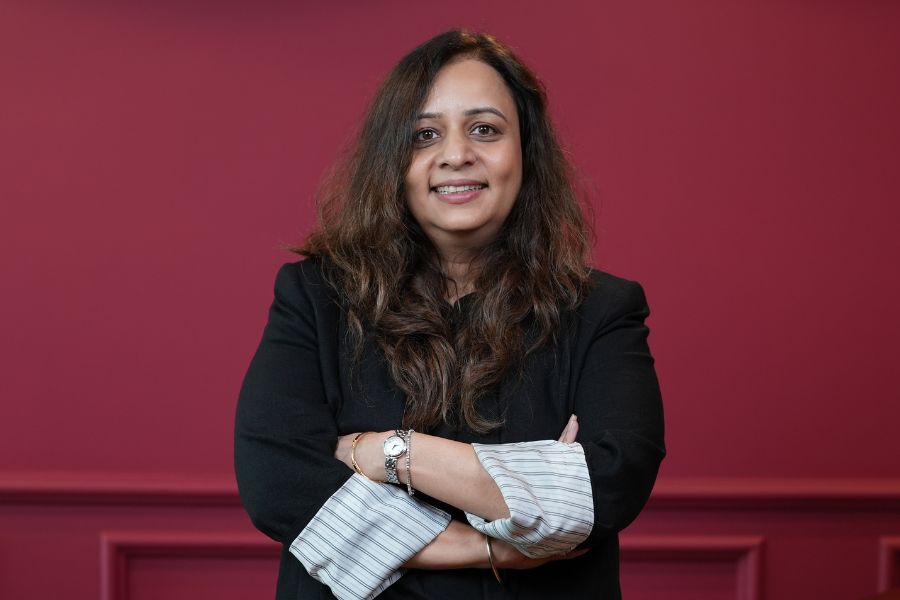
For Vandana Verma, the transition from the structured corridors of international advertising networks to the unpredictability of a start-up has left a major psychological shift. After decades at Ogilvy, DDB, and Publicis, where she was a core part of the teams building value for global conglomerates, she co-founded Wondrlab in 2020 alongside Saurabh Varma and Rakesh Hinduja. In the process, she found that a specific noun had vanished from her vocabulary: fear.
“Personally, the shift from corporate professional to founder made me a stronger person, where the sense of fear disappeared from my life,” says Verma, Wondrlab’s co-founder and managing partner. “When you’re breaking down and solving problems daily, there’s no room for fear.”
That lack of trepidation was tested early, even in the mundane task of trademarking. The company’s name, interestingly missing an ‘E’, was not an exercise in minimalist branding, but a result of pragmatic necessity.
A third party held the trademark for ‘WonderLab’ with an ‘E’ in perpetuity and refused to sell. The founders simply dropped the vowel and moved on. “Now, when somebody spells Wondrlab with an E, I tell them that’s a spelling mistake,” Verma notes matter-of-factly.
The platform-first thesis
Wondrlab entered a crowded Indian market not as a traditional agency, but with a platform-first thesis. The ambition was to build a martech firm that used a technology lens to solve brand problems, rather than relying solely on the legacy managed-services model. The strategy was to develop or acquire products and layer them with services, allowing brands to access the full marketing funnel regardless of their scale.
In the five years since its inception, the group has developed a proprietary stack of platforms built from the ground up or heavily re-engineered post-acquisition. One such pillar is Wisr, a marketing-to-kids platform that aggregates schools across India, providing brands with a singular touchpoint for a demographic that is traditionally difficult to reach at scale.
In the performance marketing space, the group acquired Neon and subsequently built Hector, an Amazon-first e-commerce subscription model. Hector now operates across India, the US, and Canada, functioning as a tool for brands seeking to optimise their presence on retail platforms like Amazon and Flipkart.
Similarly, the acquisition of Opportune—at a time when influencer marketing was still nascent—allowed Wondrlab to build a data-heavy SaaS platform. What began as a base-level tool for barters has been transformed into an end-to-end campaign delivery system for influencers.
Supporting these platforms is an in-house tech backbone provided by Cymetrix and BigStep, ensuring that UI/UX design and coding are handled internally rather than outsourced. “In the first 1.5 years of our existence, we started primarily with managed service,’ Verma explains. ‘Today, the funnel is completely the opposite.”
The power of the cross-sell
Wondrlab currently services roughly 250 clients, a mix of 200 direct-to-consumer (D2C) brands and 50 legacy corporations. While acquisitions have brought new names into the fold, Verma insists that growth remains largely organic, driven by an aggressive cross-selling strategy.
“While we may have acquired a client through an acquisition, today, that client is buying three other services from us,” she says. The logic is one of integration; clients find value in the universality of the narrative and the economies of scale that come from working across the funnel with a single entity. The ultimate goal is ‘client stickiness’, where a brand engages with the group across at least six distinct services, monitored through integrated dashboards that provide a single view of multiple functions.
This cross-selling is the engine behind Wondrlab’s reported triple-digit growth. The firm posted a 200% increase in revenue for FY24 and 185% in FY25. While one might point to a smaller starting base as the reason for such steep trajectories, Verma maintains the momentum is sustainable as the firm enters its fifth year and expands globally.
Changing the global narrative
The most striking aspect of Wondrlab’s strategy is its refusal to follow the traditional colonial path of the advertising world. For decades, the narrative in the Indian industry was defined by global networks entering the country to “In Saurabh, Rakesh, and my personal capacities, we always worked for a global network that came into India and acquired companies,” Verma says. “We’ve changed that narrative, saying India has the might to create a network within and acquire outside.”
Wondrlab is currently executing a three-phased acquisition plan targeting 26 companies. Phase one, which saw eight acquisitions, is complete. The focus is now on identifying ‘white spaces’—technologies that can solve future need gaps. This includes moving beyond hygiene-level data reporting to predictive tools, such as AI chatbots trained to manage e-commerce functions or media spend granularisation.
The selection criteria for these acquisitions are rigorous. Wondrlab looks for ‘tech geeks’—founders who have built beautiful platforms but lack the ‘brand DNA’ to pitch them to major corporate houses.
“Founders are very passionate about what they’ve built, but they haven’t had the ability to take it to brands that have the money and wrap it in the story of why it is a game changer,” says Verma. By integrating these founders but allowing them to retain their identities, Wondrlab provides the consumer understanding that complements the underlying technology.
The group’s global expansion is not merely about presence, but about identifying specific market inefficiencies. While the US market is often seen as the ultimate prize, it is also highly cluttered, with platforms like TikTok offering direct affiliate programmes that bypass the need for intermediaries.
Consequently, Wondrlab took Opportune to the Central and Eastern Europe (CEE) region, specifically Poland. The decision was driven by a gap in the market: while CEE brands are adept at using ‘hero’ content with macro-celebrity influencers for reach, they lack a distribution leg for engagement.
“What the CEE is missing, and what brands are looking for now, is engagement and brand conversations,” Verma notes. Operating out of Warsaw, Wondrlab intends to manage the full CEE belt, using India-built tech to help brands distribute content across micro and nano-influencers. The US remains on the horizon, but only once specific features are developed to handle that market’s unique nuances.
The path to IPO
With such aggressive scaling comes the inevitable question of capital. An Initial Public Offering (IPO) is firmly on the cards. However, the timing is dictated by scale rather than sentiment.
“We’re more focused on the path to IPO at the moment, where we get a certain size and scale,” says Verma. The benchmark for that transition is clear: a minimum of INR 100 crore EBITDA.
As Wondrlab prepares for its second and third phases of acquisitions, the broader industry is watching a live experiment in whether an Indian-born entity can successfully reverse the traditional flow of the advertising economy. For Verma and her co-founders, the gamble rests on a simple premise: in a dynamic market like India, the way consumers buy is constantly changing. If you can build the technology to solve those shifting problems at home, you can sell it anywhere.
For professionals in the advertising and marketing sectors, Wondrlab’s trajectory serves as a reminder that the next generation of networks may not be built on creative awards or legacy reputations, but on the ability to own the data and the coding that powers the consumer’s journey. The 'E' may be missing, but the ambition is fully present.