
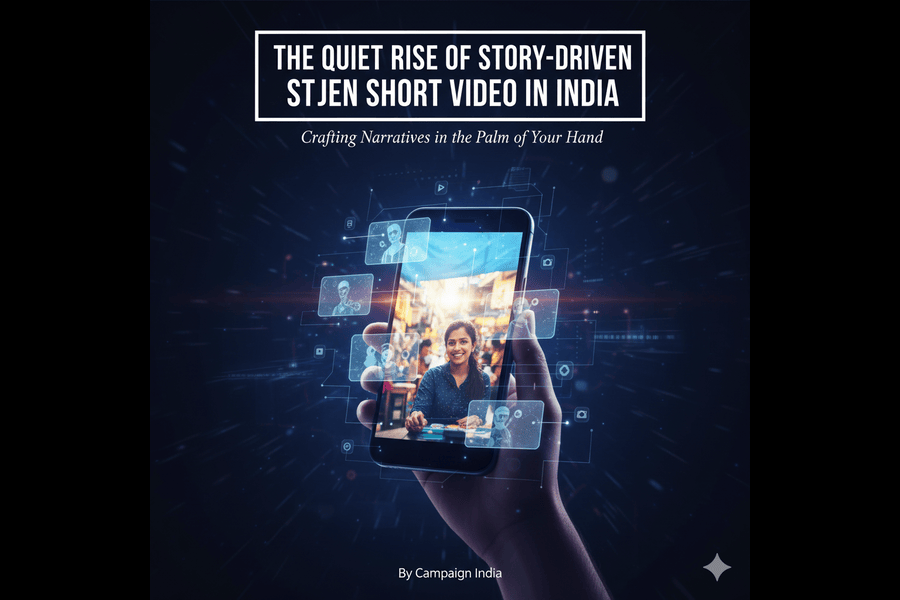
Walk through any Tier-2 city in India today and you'll notice something: people aren't just scrolling through dance videos anymore. They're following stories. Not the 15-second variety that disappears in a blink, but actual narratives with characters, cliffhangers, and episodes you need to come back for.
This isn't a sudden shift. It's been building. Apps like ShareChat, Reelies, Flick TV, and ReelSaga have been quietly carving out space in a market that seemed completely owned by the viral-or-bust crowd. Their pitch? Forget the algorithm lottery. What if short video could actually tell you a story worth remembering?
The numbers are starting to back this up. ShareChat reports over 20 Crore active users that are monetisable and over 15 Crore episodes being consumed almost every 24 hours! What’s more interesting is the fact that ShareChat is the only homegrown brand that encourages and allows active advertisers to ‘plug-in’ with first-mover credentials.
Other apps like Reelies crossed 400,000 downloads relatively quickly after launch. Flick TV hit 10,000 installs within its first few weeks—modest by Instagram standards, but meaningful when you consider these platforms are asking users to fundamentally change their viewing behavior. Investors seem to think there's something here too. Flick TV recently closed a $2.3 million round. ReelSaga brought in $2.1 million to build out their production machinery.
Here's the broader picture: over 300 million Indians are watching short-form video content right now. Industry projections put this market somewhere between $8 and $12 billion by 2030. Everyone's scrambling to find an edge. And it turns out that giving people serialized fiction—stories with beginning, middle, and end—might be one way to stand out when everything else looks the same.
Brands are paying attention. Traditional short video advertising has always been tricky. You've got maybe 15 seconds to make an impression, which usually means loud, flashy, forgettable. Micro-drama opens up different possibilities. When you've got a narrative arc spanning multiple episodes, you can integrate a product naturally. Show it being used, let characters interact with it, build associations that stick. Canva ran something called 'Calm Chori' using this format. Jeevansathi worked with ListenTBH on a similar approach. The early results suggest people don't immediately tune out when the brand shows up, probably because it feels less like an interruption and more like part of the world they're already invested in.
But this model has real challenges. Making serialized content—even at two minutes per episode—is genuinely harder than shooting a trending reel. You need scripts. You need continuity. You need actors who can carry a performance across multiple installments. Most short-video creators have never had to think this way. They've built audiences on spontaneity, not structure.
Then there's retention. Getting someone to watch episode one is different from getting them back for episode seven. Platforms have to keep the quality consistent, the pacing tight, the story compelling enough that people don't drift away. Some are testing micropayments and subscriptions, which adds another layer of complexity for advertisers who've gotten used to the straightforward reach metrics of mainstream social platforms.
Still, momentum is real. The platforms exist, they're raising money, they're finding audiences. What's happening feels less like a fad and more like an evolution—short video maturing past its adolescent phase, where everything was about going viral, into something that asks: what if we could keep people engaged not just for one video, but for an entire season?
For marketers, this means rethinking the approach. Instead of asking "how do we make our 15-second spot go viral?" the question becomes "what story can we tell over time?" Particularly for regional audiences, where nuanced, vernacular storytelling has always resonated, micro-drama offers a way in that trends and challenges never quite managed.
The battle for attention gets more intense every quarter. Micro-drama probably won't replace the feed-scrolling experience most people know. But it might carve out something adjacent—a space where people go when they want something with a little more substance, a little more continuity. If these platforms can crack the production and retention puzzle, they may have found the next genuine innovation in how India watches video on phones.