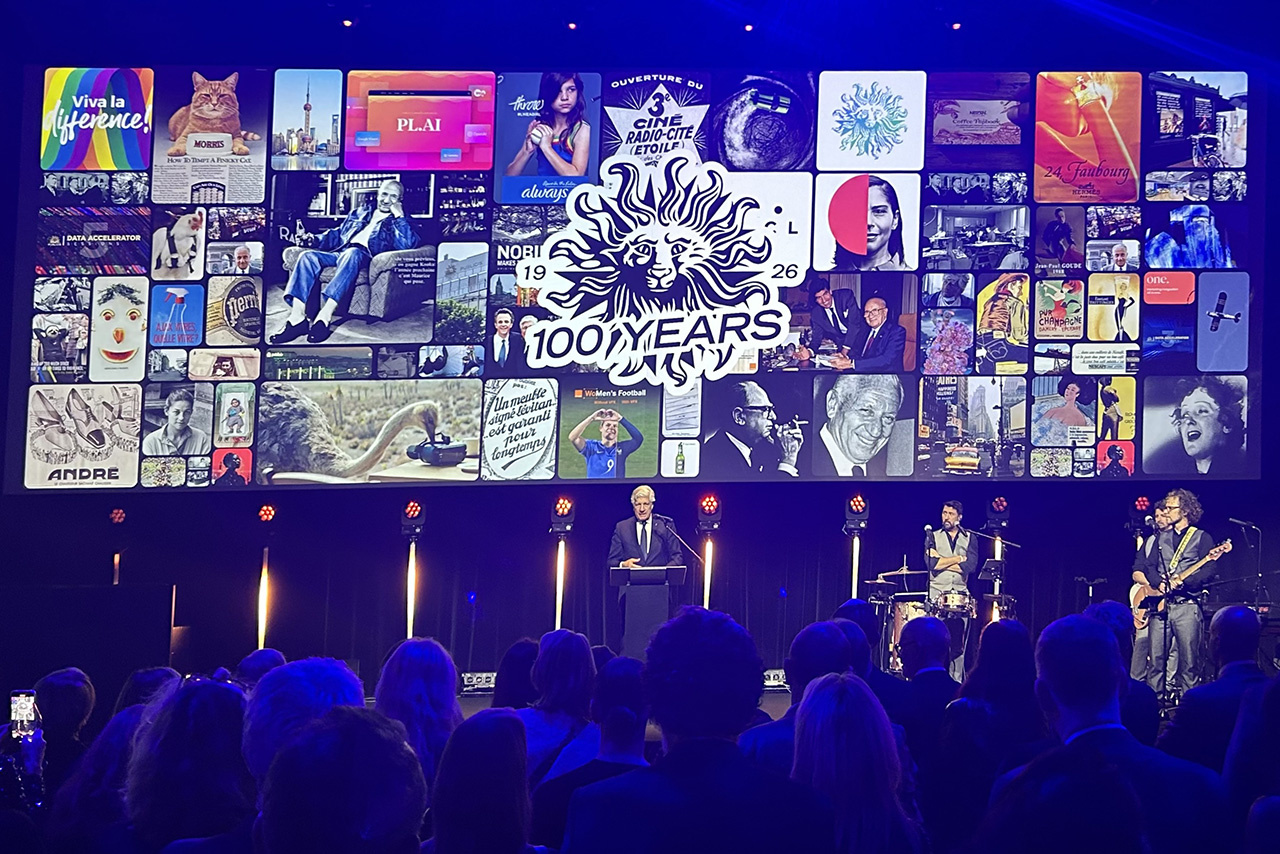
Maurice Lévy opened his address at Publicis Groupe’s 100th birthday party in Paris with a quip that he had received strict instructions from his successor, Arthur Sadoun, not to speak for too long and to confine himself to only one minute per year.
Lévy, the 83-year-old emeritus chairman and former CEO, still talked for more than 20 minutes about the history of the French agency group and its inspirational founder, Marcel Bleustein-Blanchet, who set up Publicis in 1926 and ran it for 60 years. “Marcel” was a leader who “adored advertising” and clients and had “no tolerance for mediocrity or treachery”, Lévy enthused to his audience of 750 guests.
Everything about this cocktail party, held on Thursday (December), and the wider centenary celebrations, which include a bigger party in New York this week, was about cherishing the company’s history, with a little myth-making thrown in for good measure.
Before Lévy spoke, Sadoun, the current CEO, introduced a six-minute film about the company’s roots and eventful history, seen through the adventures of the Publicis lion (the company symbol) over the last century.
The film shows the lion coping with everything from the occupation of Paris during the Second World War (when Bleustein-Blanchet fought in the French resistance) to the notorious fire in 1972 that gutted Publicis’ headquarters. Then it moves on to more recent challenges such as the pandemic and the rise of artificial intelligence. The film concludes: “A lion never gives up.”
Or as Lévy recalled, Bleustein-Blanchet telling him stoically after the fire, when a young Lévy saved some files from the burning building: “Publicis continues.”
Both the film and an accompanying 35-minute documentary stressed how Bleustein-Blanchet was always “interested in the future”, and the overriding message was that Publicis’ history will continue to inspire its future. Given that Publicis became the world’s biggest holding company last year and has been the best performer since the pandemic, Lévy and Sadoun have something to boast about.
Guests, who included senior French clients such as L’Oreal (founded in 1909) and Carrefour (founded in 1959), could be in no doubt that this is a company that cares about long-term brand-building, in the week that, coincidentally, Omnicom, its biggest rival, axed some of the most historic agency brands in global advertising.
A family affair rich in history and symbolism
The party itself was held in the Elysée Montmartre, a cavernous, 200-year-old music hall in Montmartre, the district in eastern Paris where Bleustein-Blanchet founded Publicis.
A beaming Lévy, wearing a scarf to protect against the December evening, welcomed partygoers as they passed through a pair of red velvet curtains to enter the main room. A sturdy, brown door from 100 years ago stood on display on one side — with a note explaining its significance: “On the first floor of 17 Rue de Faubourg Montmartre, Marcel Bleustein-Blanchet opened this door. He was about to create Publicis. He was 20 years old.”
There were other touches during the evening that showed this was a family affair rich in history and symbolism. Lévy used his speech to praise Elisabeth Badinter, the daughter of Bleustein-Blanchet and vice-chair of Publicis, who remains one of the top shareholders and was in the audience.
After Lévy finished his speech, Badinter joined him and Sadoun to cut a huge, three-decker cake, with “100” in gold numbers glittering on the top. Blazing sparklers around the base of the cake lit up the room as the crowd sang “Joyeuse Anniversaire”.

At the same time, an archive image on the TV screens showed an old photo of Bleustein-Blanchet, smiling and brandishing a knife, as he prepared to cut an identical-looking cake at a previous Publicis celebration.
The 100th bash was still a company party. The well-heeled Parisian crowd, mostly in black frocks and dark suits, were a mix of clients, media owners and staff. Executives in attendance included Agathe Bousquet, CEO of Publicis France, Gautier Picquet, CEO of Publicis Connected Media in France, Nigel Vaz, global CEO of Publicis Sapient, and Loris Nold, chief financial officer.
Sadoun, who let Lévy take the limelight, wanted to celebrate the centenary early, rather than wait until 2026, when the focus will be on the “new century” and taking on the competition.
On stage, Lévy made a passing reference to Omnicom, a nod to the abortive “merger of equals” that he tried with the US firm in 2013 that would undoubtedly have diluted the Bleustein-Blanchet legacy if it had been completed.
Off stage, much of the talk was about Omnicom’s just-completed IPG takeover and its decision to axe DDB (founded in 1959), FCB (which can trace its roots to 1873) and MullenLowe (launched in 1970) and make 4000 redundancies. Omnicom is following WPP, which has also ditched many of its famous creative agency brands, amid tough times for much of the sector.
Publicis has pulled ahead, thanks to its focus on media, data, technology and digital transformation, but long-serving executives weren’t gloating. They remember when their company was struggling a decade ago, before restructuring and adopting its “Power of One” model to drive collaboration for clients.
Retaining “our Frenchness”
Lévy was the undoubted star of the party. He is not only the soul of the company (“the son of Marcel”, as one executive described him) but also he embodies the company’s warrior spirit (he even quoted wartime general Charles de Gaulle in his speech).
“So what is Publicis?” Lévy asked rhetorically, near the end of his address.
It is “fundamentally French” with “a global dimension” — “familial”, “curious”, “optimistic”, “passionate”, “joyful”, “energetic” and forward-looking, he said, as he reeled off adjectives. “The great strength of Publicis is its capacity to reinvent itself.” Lévy also highlighted the company’s sense of “service” and commitment to “humanity” during his paean of praise.
From a global perspective, its ability to retain what he calls “notre Francité” — our Frenchness — has been key as the group became “fully international” in an advertising world dominated by Anglo-Saxons. That is why Publicis’ culture is about celebrating “difference” and “respecting others”, he said.
The great fire of 1972 looms large in Lévy’s psyche. “I understood something essential that day,” he said. “A company is not just made of walls, offices, buildings and computers. It’s about ‘esprit’ [spirit] — the valour which drives men and women and gives them the strength to move forward.”
Publicis is not the oldest agency group. Havas’ roots go back to 1835, and Dentsu was founded in 1902. But of the current crop of global agency names, it is Publicis that looks the most likely to be around 100 years from now, to celebrate its next centenary.
Campaign asked Lévy what “Marcel” would have thought of the 100th birthday party. “He would have been thrilled,” Lévy replied, although he joked Bleustein-Blanchet might have chosen somewhere “grander” like the royal palace of Versailles.
As Lévy likes to say: “There is no room for small dreams.”