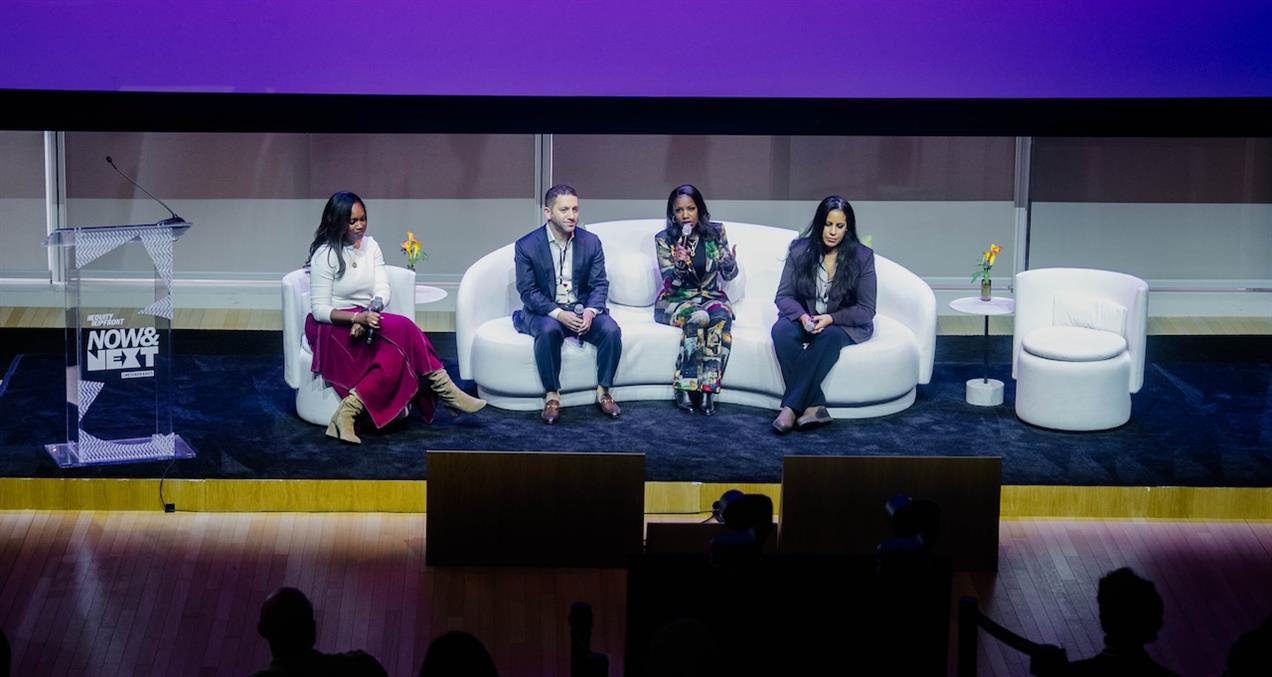
Since hosting its first Equity Upfront in 2021, IPG Mediabrands has committed to supporting minority-owned media businesses. Similar to other upfront conversations and summits held across agencies and holding companies, Mediabrands worked with these businesses to educate clients on targeting diverse audiences.
For the fifth anniversary of its Equity Upfront, Mediabrands launched its first iteration of SheFront. Held as part of this year’s Equity Upfront, SheFront focuses exclusively on women-owned media businesses, with its founders and CEOs advising clients on targeting female audiences.
“We wanted it to be impactful and meaningful for women,” shared Carol Frazer Haynesworth, IPG’s global chair of the Women’s Leadership Network and executive director of impact and inclusion, in an exclusive interview with Campaign. “I also wanted it to be contextual to the needs of women today.”
She added that the SheFront came to fruition through a “very methodic approach.” Ultimately, the day included a panel to educate marketers and clients about women-owned businesses and how they can benefit the industry. It was also an opportunity to network, so that these businesses could connect with IPG’s clients and potentially work with them.
“We’re trying to build meaningful connections,” she explained. “It was no longer about asking for a seat [at] the table; it was about creating a new table that was managed, inspired and gave us an opportunity to tell our stories.”
The women-owned platforms that spoke at SheFront included Brilla Media, Nueva Network, AdLugo and Mirror Digital.
Lydia Lugo-Karchawer, cofounder of AdLugo, told Campaign that the SheFront “opens doors.”
“I want to be able to have a place, have a voice and be able to make connections,” she said. “A lot of people have opened doors for me, so I'm hoping that through these connections, I can do that.”
Another panelist, Sheila Marnon, cofounder and CEO, Mirror Digital, said to Campaign that IPG Mediabrands has worked with the company multiple times throughout the 13 years of its existence.
“I am honored to be a part of the inaugural SheFront to showcase women leading in media innovation,” she said. “The power of women as leaders and decision-makers driving our economy is evident.”
Both the majority and the minority
Another leader behind SheFront is Channing Martin, IPG’s global chief diversity and social impact officer. Martin told Campaign in an exclusive interview that when developing the idea of the event, IPG’s Business Resource Group Women’s Leadership Network looked at the needs in the industry, mainly through the holding company’s talent, brands, strategies, business impact and consumers.
“We know that the majority of consumers are women,” she explained. “We know that over half of the global population is women. We know that the majority of the heads of households in the U.S. are led by women. Purchasing power sits with women.”
Haynesworth observed that more and more women are starting their own companies, so SheFront was a way to “keep a stronger pulse” on the conversation of women entrepreneurs.
“Do they have the resources to properly thrive?” she asked. “Even if there are stereotypes, who will correct the stereotype faster than a woman?”
Despite how much purchasing power comes from women, she continued, women-founded businesses of any and all kinds are both underfunded and “under-invested in.”
Not the term, but the essence
In today’s post-DEI society, terms such as DEI, inclusion and diversity are now discussed using terms such as culture and multicultural.
However, Haynesworth said that understanding a company’s audience is more important than being “married to the letters or the language.”
“We know who she is [as] a consumer and the buying power that she has, and so, when we look at those two opportunities, then it’s not about the letters,” said Haynesworth of women consumers “It’s about properly serving our clients by being able to tell them how they can further be intersectional.”
Martin told Campaign that even during a time when there appears to be fear surrounding what could be considered “DEI initiatives,” SheFront is simply the result of discovering both a gap in the advertising and marketing industry and a need for the business world and collaborating with others to see them addressed.
“That's what a modernised, future-forward-looking DEI strategy is intended to do,” she explained. “This work doesn’t have to be scary or exclusive; it’s intended to grow business through people that wouldn’t have an opportunity to impact the business in the same way.”
Haynesworth mentioned that, like any other kind of consumer, women are purchasing based on their backgrounds, influences and interests.
“When you look at her from that perspective, now you have amplified your opportunity by better understanding her and better targeting her,” she continued. “That separates you from the letters you might be associated with, to the opportunity.”
IPG’s legacy and commitment
With Omnicom’s acquisition of IPG expected to finish before the end of this year, both conversations and speculations regarding the future of the latter holding company’s agencies and events have yet to settle.
Given that SheFront debuted this year, it’s currently unclear whether the event will be impacted by the merger’s completion.
“It’s too soon to tell,” Martin told Campaign. “We’re going to go through a lot of change.”
Regardless of its fate, Haynesworth considers SheFront as both the “legacy” and “commitment” of IPG.
“Our commitment is decades long,” she explained. “With [the] acquisition, even at this stage, you would see our commitment not change in any way.”
Instead, she added, IPG will continue to provide support to the women in both the holding company and the industry.
“In order to create a better experience for women within our own space, we have to transform the industry,” she said. “We have to transform everyone that engages with her and all the stakeholders, because she matters, and she's at the forefront of most industries.”