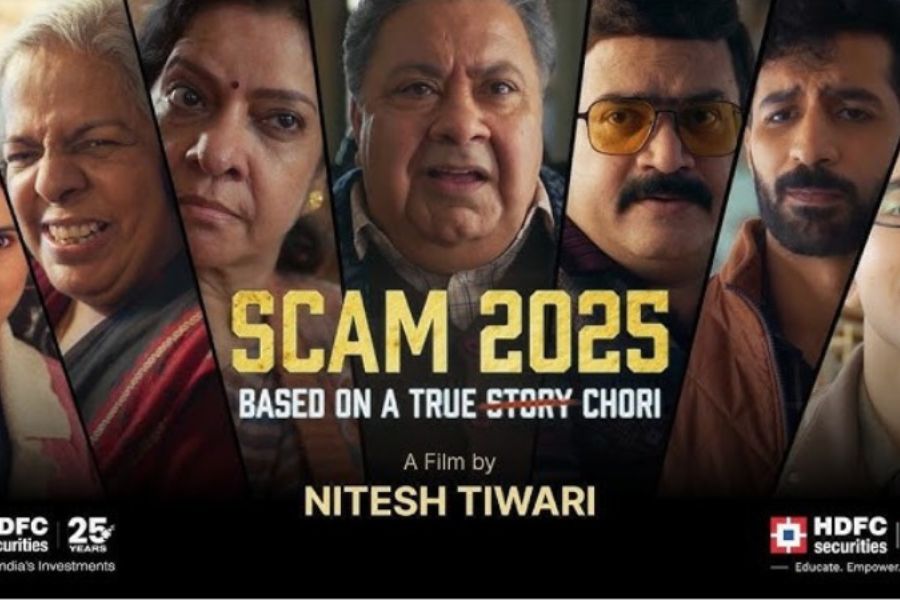
When filmmaker Nitesh Tiwari began reading the scripts for HDFC Securities’ new ‘Scam 2025: Choron ka Parivar’ (Family of Thieves) campaign, one detail stayed with him: crime rates tend to spike during the winter months—probably because people sleep earlier.
It was an unremarkable insight, yet sufficiently human to influence the creative scaffolding of the campaign, from lighting choices to character behaviour. For a project attempting to make digital fraud feel immediate, relatable and rooted in everyday experience, even within a comedic narrative, such behavioural cues mattered.
That intuition shaped a five-film series released this November as part of HDFC Securities’ Know Your Money (KYM) initiative, its flagship CSR programme focused on educating Indians about financial scams. The timing is stark.
Financial fraud in India has become increasingly structured, tech-enabled and pervasive, driven by AI-powered impersonation, fake investment platforms and sophisticated phishing networks. According to the National Cyber Crime Reporting Portal, losses from cybercrime crossed INR 22,842 crore in 2024. Only last month, the Telangana Cyber Security Bureau arrested 81 individuals linked to scams worth INR 95 crore. This is one among many signs of how organised these networks have become and continue to evolve.
For HDFC Securities, the economic cost is only part of the problem. Scams erode trust, which is arguably financial services’ most fragile currency. KYM attempts to intervene before that trust deficit widens further.
According to the brokerage’s chief marketing officer, Puneeth Bekal, the programme has already trained over 1,000 teachers and 50,000 students in government schools. “Our platform reaches around 11 million people weekly through multilingual content and community programmes,” he informed Campaign. The initiative is scaling sharply, with plans to reach 14,000 colleges across 22 states and engage 250,000 individuals next fiscal, alongside deeper outreach to gig workers, women entrepreneurs and domestic workers.
Yet this year, KYM has taken an unconventional detour.
A filmmaker’s viewfinder on a financial problem
The campaign’s new chapter, Scam 2025, trades didactic messaging for an entertainment-led universe built around a generational family of thieves struggling to adapt to digital-era scamming. Directed by Tiwari and developed with The Script Room and Earthsky Pictures, the series mirrors the grammar of a mainstream film franchise—character posters, theatrical lighting, and well-known faces such as Manoj Pahwa and Bhuvan Arora. The educational layer reveals itself only towards the end of each episode.
On paper, choosing a director known for films like Dangal and Chhichhore to lead a financial literacy campaign seems improbable. But the brief was clear. HDFC Securities and The Script Room wanted to avoid what Bekal calls “quirky or trendy advertising styles,” instead using cinematic storytelling to make financial awareness feel lived-in rather than instructional.
“We deliberately chose to bring together a content-first, cinematic storytelling team rather than relying solely on traditional advertising agencies,” Bekal explained. “The brief was to reframe financial literacy from a dry lecture into a relatable, story-driven experience.”
Tiwari’s leaning towards human-centred conflicts and observational humour gave the series its emotional architecture. Central to it is a distinctly Indian social pattern—what Tiwari described as “social scrutiny after being scammed.” Shame and fear of judgment often prevent victims from speaking out, creating fertile ground for repeat fraud.
When asked whether this interpretation came from personal experience, Tiwari didn’t hesitate. “Personal experience, of course. I remember receiving these messages myself,” he said. “These ‘scam artists’ are quite talented. Portraying the awkwardness and social reactions was a conscious choice. Humour and observational storytelling help reduce stigma and encourage open discussions.”
His interest in behavioural nuance shapes the arc of each film. Scenarios begin with familiar moments, be it a suspicious message or an irresistible offer, before pulling viewers into a fictionalised “fraudsters’ training school,” a comic amplification of how scammers strategise, improvise and manipulate.
“Throughout, you’ll find subtle cues about fraud woven into the storyline, so viewers learn to spot red flags without feeling overwhelmed,” Tiwari said. Each episode concludes with a set of practical tips.
Yet humour came with its own trade-offs. The team worried that levity could undercut seriousness or distract from the core message.
Bekal acknowledged the gamble: “The brilliance of this campaign lies in its meta-approach—it’s essentially a ‘con within a campaign,’ a scam that educates you about scams. The teaser itself misdirects viewers into thinking they’re watching a Bollywood trailer.” The intent was to convert surprise into attention rather than confusion.
Why humour and why now?
As fraud networks evolve, financial platforms face a credibility paradox: the more scams proliferate, the more users question the very systems meant to safeguard them. Traditional fear-based communication has struggled to break through. Entertainment-driven formats, by contrast, can shift awareness from passive comprehension to active recall.
Tiwari’s portrayal of scammers—both cunning and comically outdated—leans into this. Episode 1 features the family grappling with the redundancy of physical locks. Episode 2 escalates into a makeshift training academy, a caricature of real-world scam operations.
Film 3 sharpens the theme by showing scams disguised as trusted brands—a tactic audiences recognise instantly, and one scammers increasingly exploit. Subsequent episodes explore impersonation, brand mimicry and the psychology of temptation, ending with the recurring refrain: “Offer unbelievable lage, toh believe na karein.” (If the offer is too good to be true, don't believe it.)
Perhaps the boldest creative decision was the misdirection that makes the series resemble mainstream entertainment. “Some viewers could be confused or feel misled,” Tiwari admits. “But we felt the emotional engagement would help the message stick.”
A multichannel push with measured traction
The campaign’s first two films went live on YouTube on November 3 and 4. By the time the fourth episode dropped, the series had reportedly crossed 12 million views. As of now, all five films have cleared 100 million views on the platform. For a CSR initiative—rather than a brand-building campaign—the scale of initial reach is notable.
But HDFC Securities is cautious in its interpretation. “To measure impact beyond just views, we focus on behavioural change,” Bekal stated.
The company monitors engagement via its #KnowYourMoney learning app, gamified modules, and collaborations with Wagons Learning, Access Livelihoods Foundation and EmpowHer India. “We encourage conversations within families and social groups to foster collective vigilance,” he noted.
The media rollout spans Instagram, LinkedIn, news portals, OTT platforms and regional print. Given that digital fraud patterns are not confined to metros, tier-2 and tier-3 penetration remains core to the plan. This includes multilingual comic strips and community-level activations.
Despite having a robust data-driven marketing stack for customer engagement, the brokerage maintains that the campaign sits firmly outside any commercial integration. “This is positioned as a flagship CSR programme,” Bekal emphasised. “Its mission is protecting Indians from financial fraud. It is not integrated into our data-driven marketing stack for cross-sell or retention.” For an industry where communication and commercial incentives often blur, the separation is significant.
Beyond the films: What comes next
The next phase of KYM expands beyond video storytelling. Planned initiatives include a podcast series featuring finance journalists, a Scam or Not challenge, a collectible card game titled Investment Heist, a Fraudster’s Dossier primer and more regional-language outreach. The aim is to build a scaffold of cues, formats and tools that nudge vigilance into habit.
For the broader communications industry, the experiment sits at an interesting intersection: a socially relevant issue framed not through fear or cautionary tropes, but through cinematic craft. It raises an uncomfortable question for agencies and marketers—when the subject is as unglamorous as financial fraud, are we underestimating what narrative craft can achieve?
At its core, Scam 2025 is less a campaign and more a test case for whether entertainment can shift attitudes around a low-attention, high-risk category. It seeks to replace embarrassment with awareness, silence with conversation and impulse with caution.
Whether it succeeds at scale will take time to measure. But its ambition, and the industry’s growing stake in the outcome, is hard to ignore.
In a market where scams evolve faster than public awareness, the challenge is no longer just reaching consumers but equipping them meaningfully. For marketers and agencies navigating trust in the digital economy, the experiment unfolding through Scam 2025 may offer clues on where the next phase of consumer education is headed.