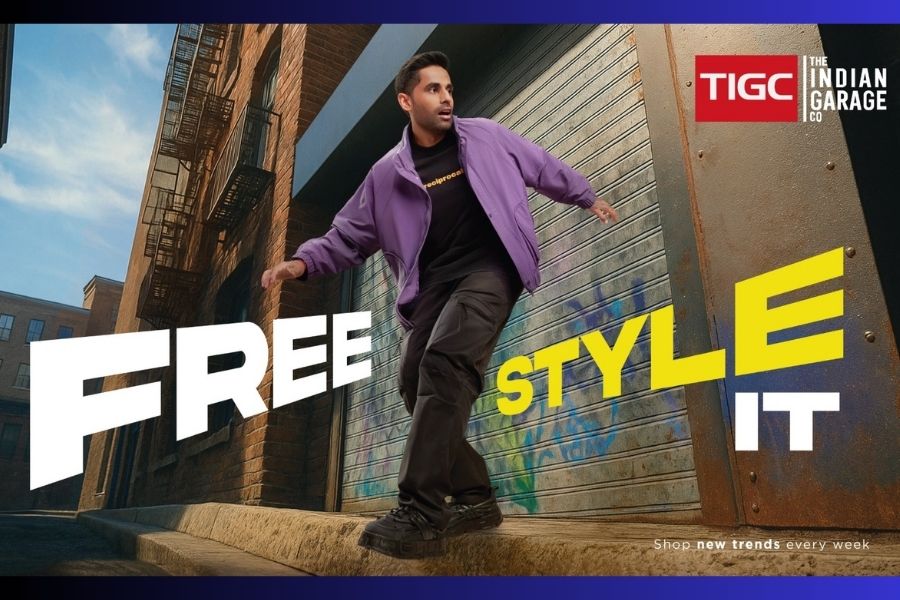
Last month, The Indian Garage Co launched #FreeStyleIt, a campaign that treats fashion less as a category and more as a mindset. Featuring cricketer and brand ambassador Surya Kumar Yadav (SKY), and created by DDB Mudra Group, the brand’s latest outing leans on a hyper-stylised visual world to argue that self-expression now outranks seasonal trends. It’s a familiar pitch in fast fashion, but Indian Garage Co frames it with a distinctly local lens, using global cues, cultural fluency and platform-specific storytelling to stake out its space in a saturated, youth-driven market.
The campaign unfolds in surreal, meticulously designed environments, which is part dreamscape, part runway, and where props and set pieces deliberately overplay scale to amplify the brand’s identity. The aesthetic pushes the brand away from the influencer-heavy look that dominates the category and towards a cinematic language intended to feel what the company claims is “unmistakably The Indian Garage Co.”
The product on display spans resort wear, streetwear and winter wear, all framed as tools of everyday reinvention. As the brand puts it: fashion that “doesn’t ask you to pick a lane because, honestly, why should you?”
A digital-first approach
Instagram leads the rollout, with YouTube driving longer-form viewing and retail stores acting as amplification hubs. The ecosystem fits a brand that grew up digital-first and now sits within TMRW, House of Brands, the Aditya Birla-backed portfolio betting on scalable, contemporary labels. For Indian Garage Co, that digital foundation is tied to a larger business promise—premium quality without the “brand tax,” supported by nationwide distribution and a broad product catalogue spanning shirts, tees, jeans, co-ords and winter wear.
What #FreeStyleIt attempts to solve is more fundamental: how does a fast-fashion brand balance aspiration with accessibility while speaking to a demographic trained to scroll past anything that smells like advertising? Founder and CEO Anant Tanted sees the answer in shifting the brand’s role.
“With #FreeStyleIt, we didn’t just want to put out another campaign; we wanted to shift how people see The Indian Garage Co,” he said. “Our campaign is less of a slogan and more of a mindset: that fashion should let you express who you are, confidently and freely.”
For Tanted, success depends on recognition and repeatability. “We are looking to grow brand awareness, improve recall, and increase both organic interest and repeat purchases,” he noted. “We will be tracking this through brand studies, search trends, and actual customer behavior on our site like product views, add-to-carts, and returning shoppers.” He believes that the campaign must not just be watched; it must alter behaviour.
That thinking extends to storytelling. The campaign’s narrative foregrounds versatility and freedom; ideas Tanted argues must translate into measurable action. “We’ll compare story-led content with more direct, product-led pieces to understand which one really drives people to add items to their cart or make a purchase,” he explained. Gen Z and millennials disproportionately act via creators they trust, so the brand will track saves, shares and conversions originating from influencer content. “For us, that’s the true measure of impact: when good storytelling moves from being liked to being acted on.”
Cultural eloquence
Cultural fluency has become Indian Garage Co’s signature, and #FreeStyleIt builds on earlier experiments—from the Kannada-language ‘Yeno?’ rap anthem to last year’s ‘Auto Anna’ reel. Each one tapped micro-communities with surprising efficiency. Tanted says the new campaign deepens that approach. “We will measure success by looking at real community impact, not just social media numbers,” he said. Metrics now include authentic user-generated content, repeat creator collaborations and meaningful comments. Conversion and repeat purchases remain the final hinge, tying community energy back to commercial value.
Long term, the ambition is not imitation. “Our goal isn’t to be India’s Zara; it is to create something truly homegrown,” Tanted said. His vision is a blueprint for modern Indian fashion that is “global in style but rooted in our culture.”
That means adapting global silhouettes to the Indian climate, colour preferences and fit expectations, then packaging them at prices that broaden access without diluting design. As he framed it: “We want to make great style accessible to everyone while keeping it deeply connected to the community that inspires it.”
For its agency, DDB Mudra Group, the creative brief centred on tapping a generational truth. As their spokesperson explained, “Gen Z uses fashion as a performance. Every day presents a new opportunity for them to embody someone new and every piece of clothing speaks to the main character energy in them.”
Versatility, therefore, was not a styling choice but a behavioural insight. “Marrying the consumer truth with the brand truth, we landed on #FreeStyleIt as an attitude that represents Gen Z across fashion and life.”
The agency’s KPIs widen beyond reach. In-store footfall and website traffic serve as the tangible ROI levers, reflecting Indian Garage Co’s push into physical retail and D2C scaling. Social sentiment and the “quality of conversations” provide the softer signals of whether the brand meaningfully shifted perception.
Instagram functions as the campaign’s nucleus, not just a distribution point. The brand’s pre-existing online community informed the media mix, giving the creative team confidence to build vertically—long-form film on YouTube, high-frequency content on Instagram, and retail amplification as the final touchpoint. Behind-the-scenes clips with SKY anchor the Instagram approach, designed for shareability and repeat viewing.
Saying it as it is
With fashion brands increasingly pivoting towards cinematic storytelling, the hyper-real aesthetic in #FreeStyleIt was a deliberate form of disruption. “We knew we needed a distinct visual world and identity… to truly stand out in a category as saturated as fashion,” the spokesperson said. “We found an interesting space in using the hyper-stylised world to truly make the clothes stand out, which helped elevate the existing perception of the brand.”
At the centre of the campaign is SKY, whose on-field persona mirrors the brand’s narrative. For him, the collaboration is more participatory than transactional. “From the beginning, my partnership with The Indian Garage Co. has been more than just wearing the clothes; it’s been about representing a mindset,” he said. The creative process, he added, is “always a conversation, not a script.” That dialogue fuels the authenticity he believes is essential for youth audiences. “Fashion today is about attitude more than anything else. It’s how you show who you are without saying a word,” he said. What made the campaign feel “genuinely me,” he noted, was that every look felt like something he would naturally wear off the field.
As Indian Garage Co plots its next phase in a fast-fashion landscape defined by rapid cycles, digital-native behaviour and cultural fragmentation, #FreeStyleIt signals how the brand wants to be seen: grounded in Indian identity, fluent in Gen Z codes, but intent on carving its own lane. The campaign leans heavily on cinematic language and platform strategy, yet the strategic question it grapples with is classic—how to convert attention into affinity, and affinity into action.
For marketers and agencies tracking the evolution of India’s fashion ecosystem, Indian Garage Co’s moves offer a preview of how homegrown brands are rewriting the category. The aesthetics may be surreal, but the ambition is entirely real: building a brand that flexes across channels, cultures and contexts without losing its centre.