If you listen to the current global chatter, you’d think men are an endangered species and the culprits are… women with (paid) jobs.
Recently, three rather opinionated voices gathered in a The New York Times (NYT) studio to record a podcast titled ‘Did Women Ruin the Workplace?’. Podcast host Ross Douthat and his ‘conservative feminist’ guests Helen Andrews and Leah Libresco Sargeant spent an hour trying to answer a question no sane society should have even framed. Of course, the internet caught fire. Apparently, when you suggest that women’s presence has made the office too empathetic, people don’t applaud.
Meanwhile, in The New Yorker, writer Jessica Winter calmly disassembled podcast-professor Scott Galloway’s latest manual on manhood, Notes on Being a Man—a ‘provide, protect, procreate’ sermon that sounds less like modern masculinity and more like instructions for a medieval livestock minder.
Winter pointed out, correctly, that much of this ‘male crisis’ talk is a tantrum polished until it resembles a thesis. It’s the intellectual equivalent of that Calvin and Hobbes strip where Calvin gets a lower score than a girl and immediately blames biology.

Today’s masculinity gurus have simply swapped the playground for podcasts and are delivering the same complaint in ‘adult’ voices.
The idea that women have ‘ruined’ anything is especially adorable in India, considering reality. The female labour force participation rate hovers around 32–33% while men lounge at 77%. If women have indeed stormed the workplace, they must have done it in stealth mode.
Meanwhile, women still do three to four times more unpaid domestic work than men. If anything is broken, it’s women’s backs, not men’s careers.
Given this backdrop, there is a definite need for an aspirational vision of masculinity. The question is, how do we define it?
To start with, let’s talk about cuss words. (Yes, it’s relevant. Very.) The default North Indian abuse not only insults the man but drags his mother and sister into the line of fire. Imagine building a linguistic culture where every second joke is a blueprint for violence against women and then wondering why violence against women is common.
Of course, patriarchy doesn’t just live in language. It puts on a baniyan (inner vest) and kills. India recorded 6,100+ dowry deaths last year. Women influencers are being murdered by husbands and partners, punished for daring to have visibility, ambition or followers.
The irony is that patriarchy has such a sturdy fanbase that even women help maintain it. Take the excellent Anouk ‘Bold Is Beautiful’ film: a pregnant employee’s female boss practically tells her she must choose between motherhood and ambition. This is patriarchy subcontracted. On the NYT podcast, both conservative women politely scolded ‘liberal feminism,’ but what they were really offering was patriarchy in pearls. Different branding, same product.
And then there’s our homegrown masculinity influencer industrial complex, generously supported by Bollywood. When Animal stormed the box office, we learnt that a significant chunk of Indian men believe the ideal male specimen communicates primarily through grunts and punches. Hyper-violent, hyper-possessive, emotionally stunted ‘alpha males’ are sold as aspirational, complete with background score and box office numbers. Andrew Tate need not immigrate; Sandeep Reddy Vanga has the franchise rights.
The popularity of Animal doesn’t just tell us that misogyny exists. It tells us it’s flourishing. It reassures a certain kind of male viewer that his worst instincts aren’t a problem; they’re proof of his manliness. That’s precisely why we need aspirational masculinity: as a counter-narrative to this cinematic glorification of animal instincts.
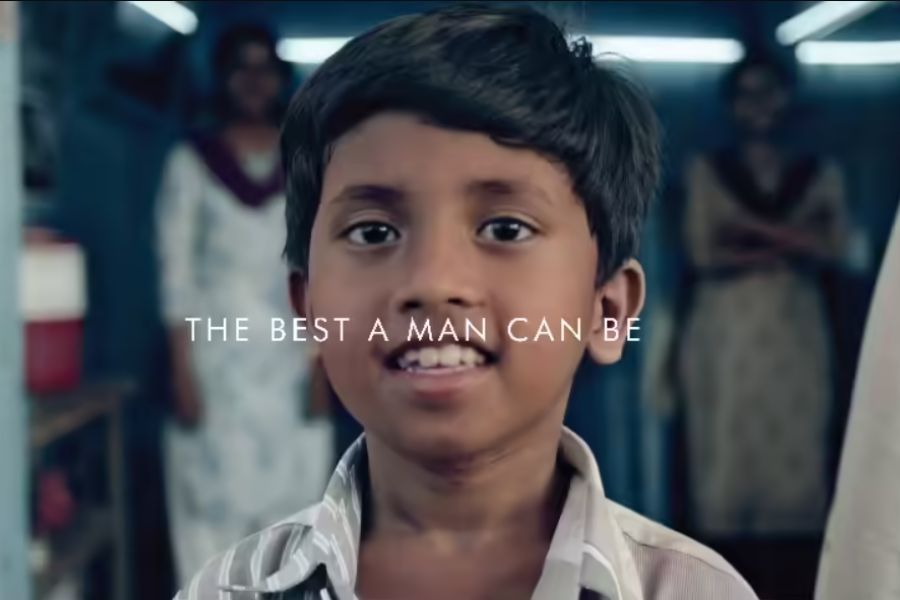
While blockbusters like Animal happily bottle toxic masculinity and peddle it to houseful audiences, the antidote has come from two places: some pioneering pieces of advertising as well as a handful of hatke (out of the box) films that quietly did the heavy lifting.
Long before Silicon Valley bros ‘discovered’ the word vulnerability, a Haryanvi father in Dangal, a small-town man with a big moustache and bigger dreams, was pushing his daughters to become world-class wrestlers. No discourse, no jargon, no podcast on feminism. Just a rural Indian dad modelling aspirational masculinity in a way Scott Galloway can only theorise about.
How advertising became the counter-narrative to Bollywood’s Mard (man)
The best of Indian advertising has been doing this for years. Ariel’s #ShareTheLoad campaign took every Indian man’s favourite delusion, “I help my wife,” and hung it out to dry. Suddenly fathers were apologising to daughters for raising sons who don’t know laundry from lungi dance. The campaign became a global case study for how ads can improve culture instead of merely surfing it.
Then came Star Plus’s ‘Nayi Soch’, which did the unthinkable: it touched cricket. MS Dhoni, Virat Kohli and Ajinkya Rahane walked onto the cricket pitch wearing their mothers’ names on their jerseys, not their fathers’. An entire country raised on patrilineal pride went temporarily silent.
Another ‘Nayi Soch’ film featured Aamir Khan updating his sweetshop signboard, not to ‘& Sons’ but to ‘& Daughters’. One stroke of paint; one century of patriarchy scratched.
And what of the transgender Bhima Jewellery ad ‘Pure as Love’, featuring a real trans woman growing into her identity under the tender support of her parents? It shouldn’t have been radical. But in a country where trans people face violence, exclusion and mockery, it became a milestone. It also reminded us that aspirational masculinity is not only about men; it’s about making masculinity large enough to embrace everyone safely.
Meanwhile, other films and series have shown better men without applauding themselves for it. Gunjan Saxena gave us a father pushing his daughter towards the Air Force. Thappad (slap) showed a father supporting his daughter’s refusal to tolerate violence. And then there was Jeetu Bhaiya (brother) in web series Kota Factory, who embodied a calm, steady masculinity built on empathy, responsibility and emotional clarity; strength without swagger. These are not superheroes. They are simply men doing what men should have been doing all along.
Still, for every step forward, there is a deodorant ad dragging us back into the Stone Age. Layer’r Shot aired a commercial that essentially treated gang rape as a punchline until ASCI and concerned citizens stepped in. These ads don’t show masculinity; they are male regressiveness with a media budget.
And now, the pièce de résistance: even AI has internalised patriarchy. When I tried generating a video where a wealthy woman gives a young man a blank cheque, Google’s AI kept flipping the genders, because its training data simply could not fathom a rich woman funding a man. When your algorithm has stronger patriarchal conditioning than a 1980s sasural (in-law’s house), you know things are grim.
As per Kantar’s Indian Masculinity Maze survey, only 6% of male characters in ads explicitly showed respect or emotional care toward women. Just 1% of them showed men in caregiving or shared domestic roles. That’s dire.
Tell me what makes a man
So yes, we absolutely need aspirational masculinity. But advertising, media and marketing professionals need to be mindful about creating a new masculinity model that a Gurgaon consultant and a Ghaziabad security guard can both recognise as achievable. Aspirational, yes. But also accessible.
Richard Reeves, author of Of Boys and Men, frames it like this: you measure a man by the surplus he creates for the people around him, not by the spotlight he stands in. Providing isn’t just about money anymore; it’s about emotional steadiness, responsibility, and actually showing up. It’s about a man keeping his promises, sharing domestic labour, calling out harassment, checking in on friends’ mental health and taking responsibility at work. That’s the hard stuff. And precisely because it’s hard, it’s aspirational.
The new vision of masculinity should also be a plural one, acknowledging that young men no longer see themselves as one-note cardboard-cutout heroes. They see themselves as sons, partners, friends, colleagues, each with different strengths. This isn’t patriarchy 2.0; it’s a fresh blueprint for men who want to be useful, grounded and genuinely admirable.
Oh, and coming back to women. They didn’t ‘ruin’ the workplace. They just stopped being the doormat at the front entrance.
And that, honestly, is the best thing that’s happened to men in a long, long time.
Now it’s time advertising helped them catch up.

-Sumanto Chattopadhyay, former chairman and CCO of 82.5 Communications, Ogilvy Group, and the author of Stories of Words and Phrases.