
A white paper prepared by the Economist Intelligence Unit (EIU), ‘Brand and deliver: Emerging Asia’s new corporate imperative’ looks at how companies are tackling the next stage of their evolution by harnessing the power of brands. It also shares insights from firms in Japan and South Korea that have already succeeded in building global brands.
According to the report, burgeoning economies do not translate to impressive brands. The report examines the current state of branding in emerging Asia, and notes that, going forward, branding is critical for survival not only in the local markets but also for going global. Noting that marketing is just one part of the brand building process the report points out that branding strategy, as practised in the West, is not well understood in Asia.
In some cases past growth came from being in the right place at the right time. Phone companies, for example, benefitted from new technology that radically reduced the cost of services and made them affordable to billions of new consumers. Double-digit growth then followed as companies rushed into unserved markets. Once markets are established, however, growth becomes much harder, and in the future companies will need brands to keep expanding.
In Asia, the developed parts of the region have long been successful brand-builders. Names such as Toyota and Sony in Japan, Samsung and Hyundai in South Korea, Singapore Airlines and Hong Kong’s Esprit fashion label are quite well known globally. However, the report notes that famous names from places like China, India, Indonesia and other emerging Asian economies are missing from Asia’s brand map.

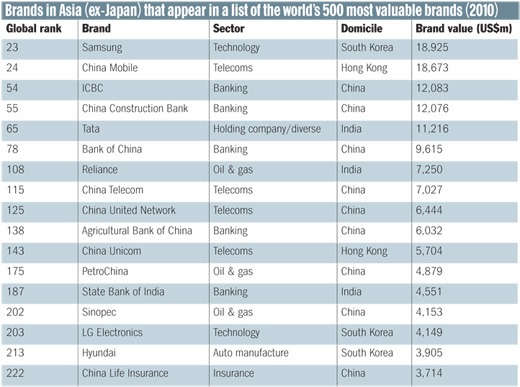
The report cites a study in 2010 by Brand Finance, a consultancy, which calculated the value of the world’s 500 biggest brands and found that Asia as a whole had 98 brands in the top 500. But strip out developed nations, and emerging Asia’s total came to just 29 brands, or 6% of the total—well below its share of the global economy. A total of 8 brands represent India in the list, making it fourth on the list after Japan (with 54), China (with 18) and South Korea (with 9).
Tata ranks highest amongst the Indian brands with a global rank of 65, and a brand valuation of US$ 11,216 million. It is the only Indian brand to make the Top 100 cut, with Reliance a distant second at 108 with a valuation of US$ 7,250 million. State Bank of India ranks in 187 with US$ 4,551 million, followed by Airtel on 289 with US$ 3,159 million. Bharat Petroleum (Rank 306), Wipro Technologies (Rank 380), Infosys (Rank 424) and ICICI Bank (Rank 440) fill up the remaining spots for Indian presence on the list.
According to the report, historically, Asian companies have competed on price, operated with a trading mentality, pursuing numerous opportunities, often diverse and short-term while the report stresses on the need for a longer-term and more focused approach for managing a branded business. It states there are many routes to going global with a brand but targeting emerging markets first after establishing the domestic presence offers the best chance of success. Citing the success stories of Japanese and South Korean brands, the report point out that quality and safety are critical to brand success for emerging multinational companies.
The report also touches upon the need for increasing investments in R&D, marketing and design along with recognising both the positive and negative aspects of their origin and heritage, as key points for emerging multinational companies to build successful brands.
Many branding experts believe the time needed to build a global brand is shortening, thanks to a more globalised world, faster communications, more pervasive media and the internet. While Japanese companies took 40 years, and South Korean companies took 25 years, Chinese and Indian companies might only need 10 to 15 years. The report attributes the accelerated growth to a more globalised world, faster communications, more pervasive, media and the influence of the internet. The report, prepared following exclusive conversations with these branding experts, opine that this shortening time frame will add further pressure on firms to manage brands competently.
The report also focuses on the so-called “country of origin effect”, whereby Asian brands when going global, are perceived as being inferior because they come from a foreign country that customers don’t understand, or which they mistrust. It cites the example of Hindustan Lever, a subsidiary of Anglo-Dutch conglomerate Unilever, which is viewed by many as a local brand, to drive home the point. EIU also stresses that to stay at the front companies must nurture their brands diligently. That means ensuring the highest levels of brand consistency around the world, measuring regularly how the brand is perceived by customers and staff, and having processes for dealing with issues such as product recalls.

Another example cited by the authors of the report, shares the Tata story of not rebranding Tetley, even after it made headlines for its high profile global acquisitions. “Tata means nothing to Mrs Robinson in Bedfordshire, but Tetley means a great deal,” says R Gopalakrishnan, executive director of Tata Sons in the report. Instead, the conglomerate has launched a more subtle campaign to win foreign friends, bringing young graduates from Europe and America’s leading universities to India to see Tata’s much admired CSR programmes at work.
The report observes that companies in emerging Asia, which experienced staggering growth in the past two decades without needing to build brands, have to change swiftly making ‘brands’ a must-have assets. Explaining the rationale of building brands in a nutshell for this market, the report stresses that there is no one-size-fits-all strategy for Asia’s emerging multinationals. It notes that some are building them in their home markets and then using that as a platform to take the brand abroad, while others are looking to buy existing brands in foreign markets—a fast-track strategy, but one that demands huge experience and skill on the part of the acquirer.
Summing up, the Economist Intelligence Unit report points out that each aspiring brand in emerging Asia will have to find its own way. It goes on to state that over the past 50 years, the Japanese and Koreans have successfully embraced branding, and companies such as Toyota and Samsung now lead their sectors; and, is surely only a matter of time before a new generation of brand-leaders from China, India, Indonesia and other countries are challenging them.