

Topline
The Indian Advertising expenditure is expected to touch the 300 billion mark by end of 2011. TV is expected to overtake Print to be the lead medium in India and will continue to grow at 26%. Print is expected to have a moderate growth of 9% as compared to the other mediums. Digital is expected to be growing at 35%. Though it will be the fastest growing medium, it will not grow at the expense of TV or Print.

TV – OUTSTRIPPING PRINT

As per the IRS R3, TV penetration is 79% out of which 69% is Cable & Satellite. The real growth in TV advertising is coming from these homes. TV penetration has grown by 5% whereas C&S has grown by 7% over 2009-10.Some of the key factors for growth in Television are:
1. Competition and Growth expanding the market This has given rise to consolidation of operations. 2010 witnessed the adverse impact of the growth on smaller players, who found it difficult to survive in the given scenario. The players which were able to weather the downturn are likely to look at enhancing their market shares. This could help in the emergence and growth of players with superior product, marketing, distribution, technological and innovation capabilities. In turn, this is likely to aid the growth in the overall market size and reach for the industry. Mergers and acquisitions activity in this space over the next two years is expected to significantly increase along with the level of participation by private equity players.
2. Fragmentation leads into broadened horizons Entry of newer customers, players and regions are on continuous increase and are thereby creating wider inroads in other domains beyond their traditional home grounds.Also, players from other sectors like IT,Telecom, etc. have entered the industry. Foreign players are also looking at increasing investments in their Indian portfolios.
3. Regionalisation fuels market growth and allows convergence of medium Growing regionalisation is also helping some regional players to become strong by tapping newer markets. Also, media players are looking at leveraging their content across platforms leading to the emergence of conglomerates.
4. Cricket has become a regular phenomenon with more than 150 days of India playing cricket. 2011 will, for the first time, see the World Cup & IPL in the same season The demand for these tournaments has been high with each of them locking in the sponsors well before 2011. With both expecting to garner almost 1500 crores, it is becoming a separate genre on its own. Today, advertising just on-air on cricket is estimated to be in the region of Rs.1100 –Rs.1300 crore. Next year, it is estimated to grow to Rs. 2200 crore. It continues to remain the single most entertainers across the nation.

5. Newer markets are being tapped by media. Regionalisation not only includes all the four South markets, but now additionally we can include West Bengal and Maharashtra. Media plans no longer work on the regular channel spill-over. Markets like UP, Punjab are seeing the advent of regional specific channels such as Mahua TV.

6. Embracing Digitisation: Availability and penetration of newer distribution platforms like Digital Cable, DTH and IPTV. The industry has benefited from digitisation and the growth is likely to continue in the years to come. Currently, DTH is growing at the rate of 30% and is expected to reach a base in excess of 30mn household by the end of 2011.
The digitisation of TV platforms has resulted in:
a. better technology and picture and sound quality for viewers

b. more transparent distribution of revenues for stakeholders in the value chain and more bandwidth becoming available to broadcasters, giving them opportunity to provide value-added services.

All this has led to growth in advertising on DTH by:
a. availability of newer avenues
b. possibility of more target specific advertising
c. interactive content/ gaming/ sales!
d. HD Feeds being available
e. language options
f. the ability to record and view live content
7. More is less : Content hunger grows (Tentpoles and Reality shows): New Seasons of Bigg Boss, newer Formats like Master Chef, Celeberity programmes, Blockbuster Movies, Award shows, Dance Programmes, etc., etc. — the list is just increasing. Approximately 20% of total programming time is devoted to Reality shows, up from 16% in 2010. These shows have high input costs, which are mainly due to:
a. Celebrities
b. Outdoor Shoots
c. Expensive Production
d. High Marketing Costs

8. Niche —Fragmentation and the emergence of the Long Tail Today channels are available for our specific needs. If you have interest in, say, Gadgets, Health, Food, Cars, etc., there is a TV Channel that catesr to your specific needs. Each channel will cater to a specific Target Audience with a specific profile. 2011-12 will witness the emergence of the Long Tail.

Read Vikram Sakhuja's views on what's in store in 2011 in his Mindshare India Predictions 2011 piece here
Read R Gowthaman's views on what's in store in 2011 in his Mindshare India Predictions 2011 piece here
Read M A Parthasarthy's views on what's in store in 2011 in his Mindshare India Predictions 2011 piece here
Read Prasanth Kumar's views on what's in store in 2011 in his Mindshare India Predictions 2011 piece here
Read Alok Sinha's views on what's in store in 2011 in his Mindshare India Predictions 2011 piece here
PRINT – THE NEW NORMAL
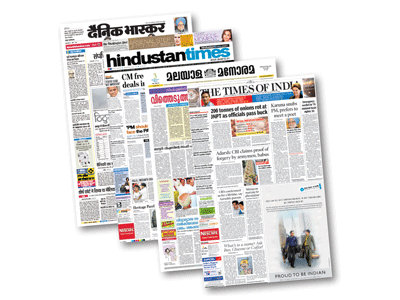
After a slowdown in 2009, Print in 2010 grew by 26%. In 2011 it is expected to grow at 9%(Jan – Dec) to bring the Print AdEx to Rs. 13211 crores With these growth figures Print will be back to the similar levels of 2007 -08.
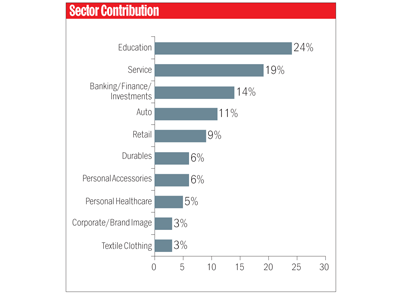
Print growth is driven largely by the dailies. The volume growth came from almost all sectors with Education and Services being the leading categories.
Key Trends which will affect Print Growth in 2011 are:
1. Expansion: Publication groups are expanding vertically into newer markets. For example, The Times of India has expanded into Chennai and is now looking to enter Kerela, either through acquisition or new launches. Secondly, publications are horizontally expanding into other genres and verticals such as Finance, Health, Real Estate etc.
2. Diversification: Radio, Digital, TV , Events are some of the areas where Publication groups are expanding and are now offering 360 degree solutions under one roof
3. Digital The Comscore Plan Metrix report shows that, in developed markets like US, Print is losing share year on year at the rate of 11% to digital. This trend has not caught on in India. After a slow 2009, Print has bounced back with an estimated growth of 9% in 2011. However, the challenge is that readers will spend lesser time on the medium and overall readership will continue to sufferand& ultimately it will follow the global trend.
CINEMA GOING DIGITAL
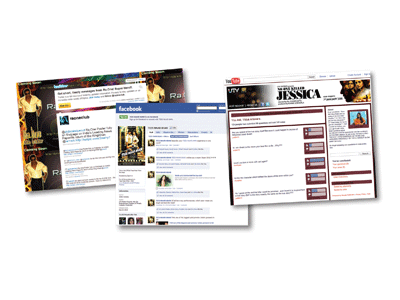
Year 2010, was a good year for cinema advertising as it clocked 121 Cr. (2009 which had a cinema strike for 3 months). Cinema is expected to grow @ 16% in 2011 mainly due to:
1. Total Digital screens cover approx. one-third of the total screens in India (where advertising is done) i.e. 3000 screens. Also, movies being released on an average have 60% dependence on digital screens Vs print screens which adds to saving costs for the distributor.
2. Better movie titles with top stars in 2011 like Ra1 (Shahrukh Khan), Don2 (Shahrukh Khan), Sultan (Rajnikanth), Untitled Name – Aaamir Khan
3. Movies will be releasing during the 90 days of cricket in 2011 (like the World Cup, IPL4, etc happening in India) unlike the last year where there were absolutely no releases during IPL
4. Multiplex screens which comprise of approx 1300 screens will see aa 15% growth to 1500 screens in 2011.
5. Multiplex screens to open in tier 2 & 3 towns. Metros to witness more Gold Class theatres like PVR.
Read Vikram Sakhuja's views on what's in store in 2011 in his Mindshare India Predictions 2011 piece here
Read R Gowthaman's views on what's in store in 2011 in his Mindshare India Predictions 2011 piece here
Read M A Parthasarthy's views on what's in store in 2011 in his Mindshare India Predictions 2011 piece here
Read Prasanth Kumar's views on what's in store in 2011 in his Mindshare India Predictions 2011 piece here
Read Alok Sinha's views on what's in store in 2011 in his Mindshare India Predictions 2011 piece here
RADIO THE BUZZ MEDIUM
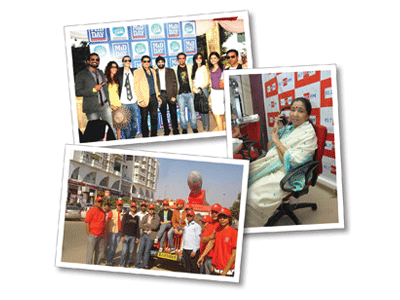
1. The Radio Industry in 2010 is estimated to close at Rs. 1325 crore (approx.); estimated growth of 25% by 2011 – Rs.1653 crore . (approx).
2. Phase III bid announcement expected soon. 700+ new licenses in 235+ cities to be open for bid. Apart from syndicated news / current affairs broadcast, multiple frequency and increase in FDI limits could be the icing on the cake.
3. International radio stations have begun syndicating content to Indian FM stations. This development will:
a. Help in dealing with the lack of celebrity quotient for smaller players
b. Help in cutting costs especially in the late time bands in smaller markets
c. Increasing the risk taking ability to try new formats in the smaller markets and smaller players
d. Help as an image booster
Some international radiocasters are believed to be attempting to lure the national FM players with pan India presence through high value deals
4. Radio is also being used as a buzz medium. With a lot of clients, radio seems to fit in as the best medium for activation and instant amplification.
5. Top 5 metros still account for approx 50% of ad revenues; advertisers yet to realize the potential of the tier 2 & 3 cities (<10 L pop-strata)
6. AIR is sitting on the digital edge as it awaits final clearance of Rs. 5900 crore required for completing digitalisation of AIR spread across 10 years. Pilots have already begun with AIR choosing Digital Radio Mondale technology over HD technology
7. 64 community radio stations currently operational in the country and growing rapidly with government help. Exponential growth expected in the next 3 years — 4000 Community Radio stations to open.
8. Mobile radio being experimented by lot of players
9. When RAM started, Radio was around 3 per cent share of the advertising pie, and today we are talking about four and a half percent. It has potential to touch 7 to 8 %. For this to happen, radio networks will have to work on getting some of the dominant sectors which are heavilty print-dependant to move to radio. Television advertisers who are spending on secondary and tertiary channels (regional channels) should are potential radio advertisers
10. Marketing alliances between radio stations for monetisation and sustainability has become a standard in the Indian radio industry. But now radio stations are eyeing station acquisitions to increase their footprint and corporate houses are planning investments to break into the Indian radio business. The current Information and Broadcast ministry regulations restrict the tradability of radio licenses till the completion of five years of existence, which ends in 2010. The Association of Radio Operators of India (AROI) has been lobbying with the government to reduce the restriction of tradability of license from the current five years to three years.
11. Other regulations like non-availability of multiple frequencies, license term period of ten years also pose a hindrance for the industry.
12. The Government is expected to permit relay of All India Radio news (unaltered) by private FM radio channels on such terms and conditions as worked out with PrasarBharati, according to Information and Broadcasting Ministry sources. The government is, thus, in the process of rejecting the view of Telecom Regulatory Authority of India (Trai) that news should be allowed to be accessed from AIR, Doordarshan, Press Trust of India, United News of India, and any other authorised news agency or television news channel.
DIGITAL - GETTING SERIOUS
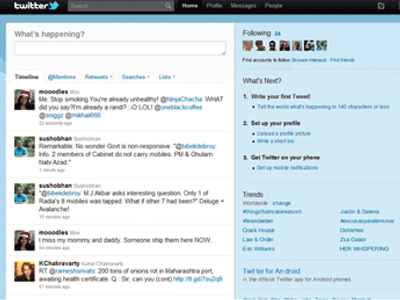
2011 will be the era of the digitisation of media planning. Digital, from being a niche medium, will start being the mainstay medium for categories such as Retail, Auto, Insurance, Service Industry and FMCG. We expect digital to grow by 35% (albeit from a smaller base). With Rs. 1573crore, digital’s contribution to the AdEx will be similar to that of Radio. Google’s search volume has increased by 700% within the last 2 years.Facebook has started operations in India and Linkedin has already tied up with advertisers such Volkswagen, Taj Hotels and more.
Some key observations /trends in this direction are:
1. Flirtatious to a serious relationship: Every Advertiser in the country in one way or another has been flirting with Digital. Our estimates indicate that approximately 1-2% of the marketing budget is towards Digital. (This number would vary from Advertiser to Advertiser & across Categories). Increasing usage & time spent is making this medium unavoidable & if we were to take any indications from Global trends especially the Forrester report in the US time spent on Digital is higher than Television. Categories like IT/ ITES, FMCG, Telecom have already increased their contribution to Digital and competing heavily with Online Companies, BFSI & Travel. Contribution expected to cross 10% for certain brands. The online Video market will compliment the TV spends from Saliency and rich media presence will grow significantly from Impact perspective
2. Cricket & Blockbusters being streamed Live on Digital. A trend started during IPL3 where the matches were relayed live on You Tube. Approximately 55 million channel views and 22 million unique visitors watched cricket or sampled the highlights on YouTube. The WC 2011 and IPL4 these numbers will be surpassed. In the future we will see more and more movies being released on the Digital medium i.e. PC or Mobile. This has provided advertisers an opportunity to reach out to the youth & the upscale audience on the go.
3. Mobile is another area which will drive Digital medium. With 700 mill mobile phone connections of which 20% are smart phones mobile is one medium which will lead the internet growth in our country. Digital music distribution is mainly restricted to the telecom segment, through ring tones and caller ring back tunes. With increase in mobile and broadband penetration and expected 3G rollout, market for other digital distribution platforms such as full track downloads, streaming music and subscriptions etc might also open up. Mobile as medium will also partner with Print ad in terms of SMS, Voice & QR Codes for leveraging response mechanism; and will help distribute video content thru Blue Casting &Wap services.
4. Social Media: From just creating fan pages on uploading TVC’s on Youtube, the medium will see creation of “Owned Media” properties on FB, Tw, YT on a long term basis. A combination of online & off line activation will lead to serious content platforms being created in this space. Most brands have graduating from worrying about fan base to fan involvement. The interplay between traditional media & social media will bring out the best out of the medium. Specific budgets would be set aside for creation & promotion of such programs. Publishers will also create social media connects on FB & Tw (for Print) &Youtube (for TV Channels) and the opportunity to monetize this content will see consolidation for inventory deals.
5. Search: Content Sponsorship in terms of Cricket & Bollywood have made it easy for all to understand that TV+ Search &Print+Search provides better results than either of the medium used solo. IPL has already thrown open studies on how brands which were present on TV/ Franchise merchandise & on Search benefitted more than those who used only the former medium. Google is already contributing to about 50% of the Digital media spends in the country. The Search Juggernaut will continue to dominate as new brands increase their dependency on the query based & the network based model. e.g. Micromax has recently figured in Google Zeitgiest 2010 as the second fastest rising terms & no wonder one has noticed their increased presence on Search. Kites has been the fastest popular movie, just to mention the opportunity that Bollywood is sitting on.
6. Measurement: With IMRB starting WAM one of the key missing ingredients has been found. Digital is currently being post measured through CPM, CPC & CPA. The missing link was the Time spent but with WAM it will be also measured with the regular dynamics of Reach, Frequency & GRPs which are the comfort zones for a media planner. ViziSense tool to measure category level spends will also fuel the war to increase SOV & SOE. While, Buzz Metrics & Brand Metrics will be essential to measure the brand impact & consumer sentiments, Third party ad serving will become the norm from campaign metrics perspective.
Read Vikram Sakhuja's views on what's in store in 2011 in his Mindshare India Predictions 2011 piece here
Read R Gowthaman's views on what's in store in 2011 in his Mindshare India Predictions 2011 piece here
Read M A Parthasarthy's views on what's in store in 2011 in his Mindshare India Predictions 2011 piece here
Read Prasanth Kumar's views on what's in store in 2011 in his Mindshare India Predictions 2011 piece here
Read Alok Sinha's views on what's in store in 2011 in his Mindshare India Predictions 2011 piece here


